How Many Ounces in a Cup? 8 fl oz + Dry-Ounce Charts
There are 8 fluid ounces in 1 US cup — for liquids, that is the whole answer, every time. But if your recipe measures a dry ingredient in ounces, the answer changes with every ingredient: a cup of flour weighs about 4.4 ounces, a cup of sugar about 7 ounces, and a cup of honey about 12 ounces. Same cup, three different answers, because the word “ounce” secretly means two different things.
This guide gives you the quick answer, the full cups-to-ounces conversion charts in both directions, the dry-ounce weight of 12 common ingredients, the difference between US, Imperial and metric cups, and the measuring habits that keep your recipes working. If you have ever poured 8 ounces of flour into a bowl because a recipe said “8 oz” and wondered why the cake came out wrong, this is the page to bookmark.
Quick Answer: How Many Ounces in a Cup?
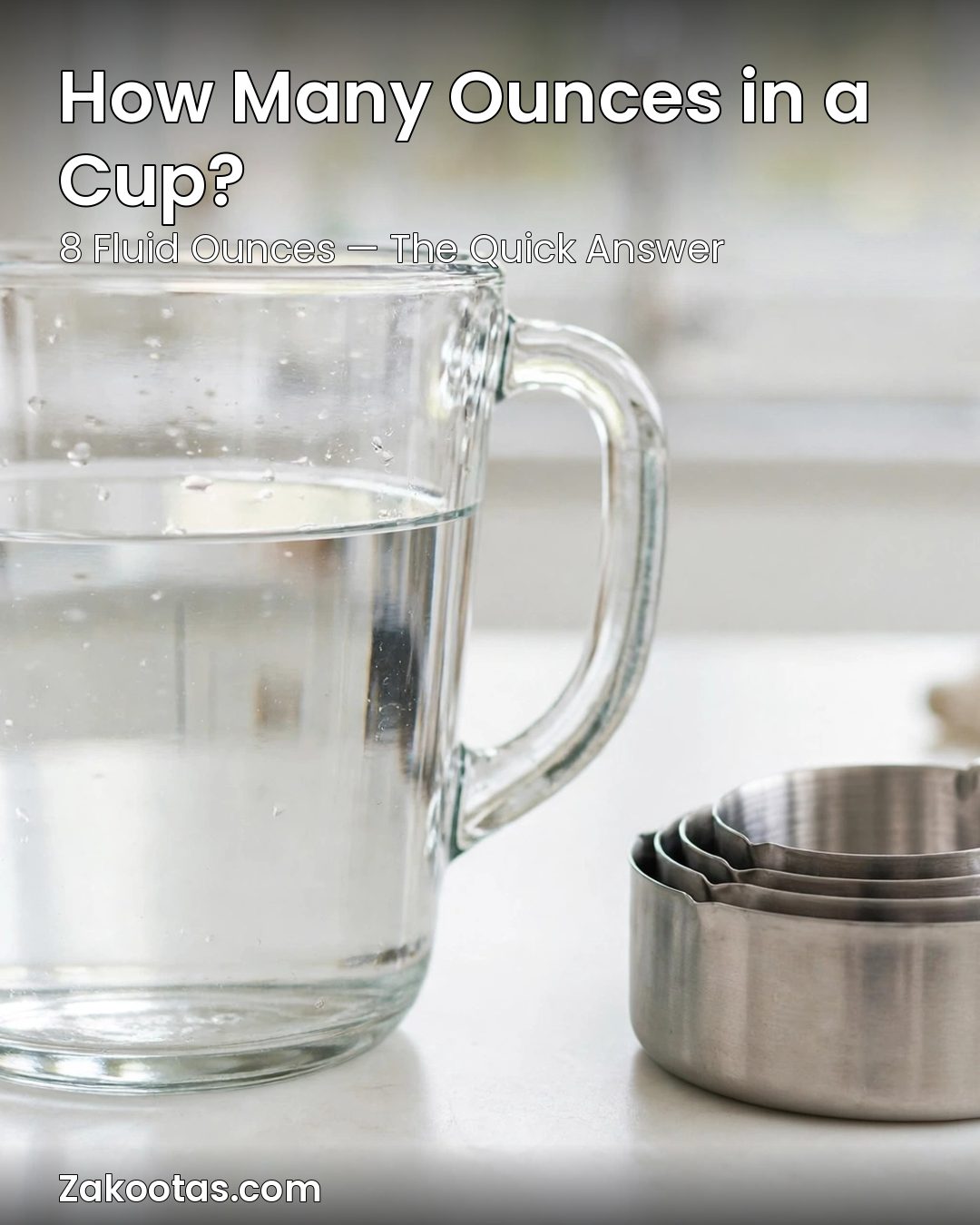
1 US cup = 8 fluid ounces (fl oz), which is also 16 tablespoons, 48 teaspoons and about 237 millilitres. That is the volume answer, and it never changes: water, milk, oil, juice, broth — pour any liquid into a 1-cup measure and you have 8 fluid ounces.
For dry ingredients the answer is different, because dry ounces measure weight, not volume. A cup of flour and a cup of honey fill the same space but weigh completely different amounts. Here is the short version:
| What you are measuring | Ounces in 1 cup | Why |
|---|---|---|
| Any liquid (water, milk, oil, juice) | 8 fl oz | Fluid ounces measure volume — always 8 per cup |
| All-purpose flour | 4.4 oz | Light and airy — a cup weighs barely half of 8 oz |
| Granulated sugar | 7.1 oz | Dense and packs well — close to, but not quite, 8 oz |
| Butter | 8 oz | Two sticks — the one dry ingredient that matches exactly |
| Honey | 12 oz | A concentrated sugar syrup — half again heavier than water |
Fluid Ounces vs Dry Ounces: The Difference That Matters
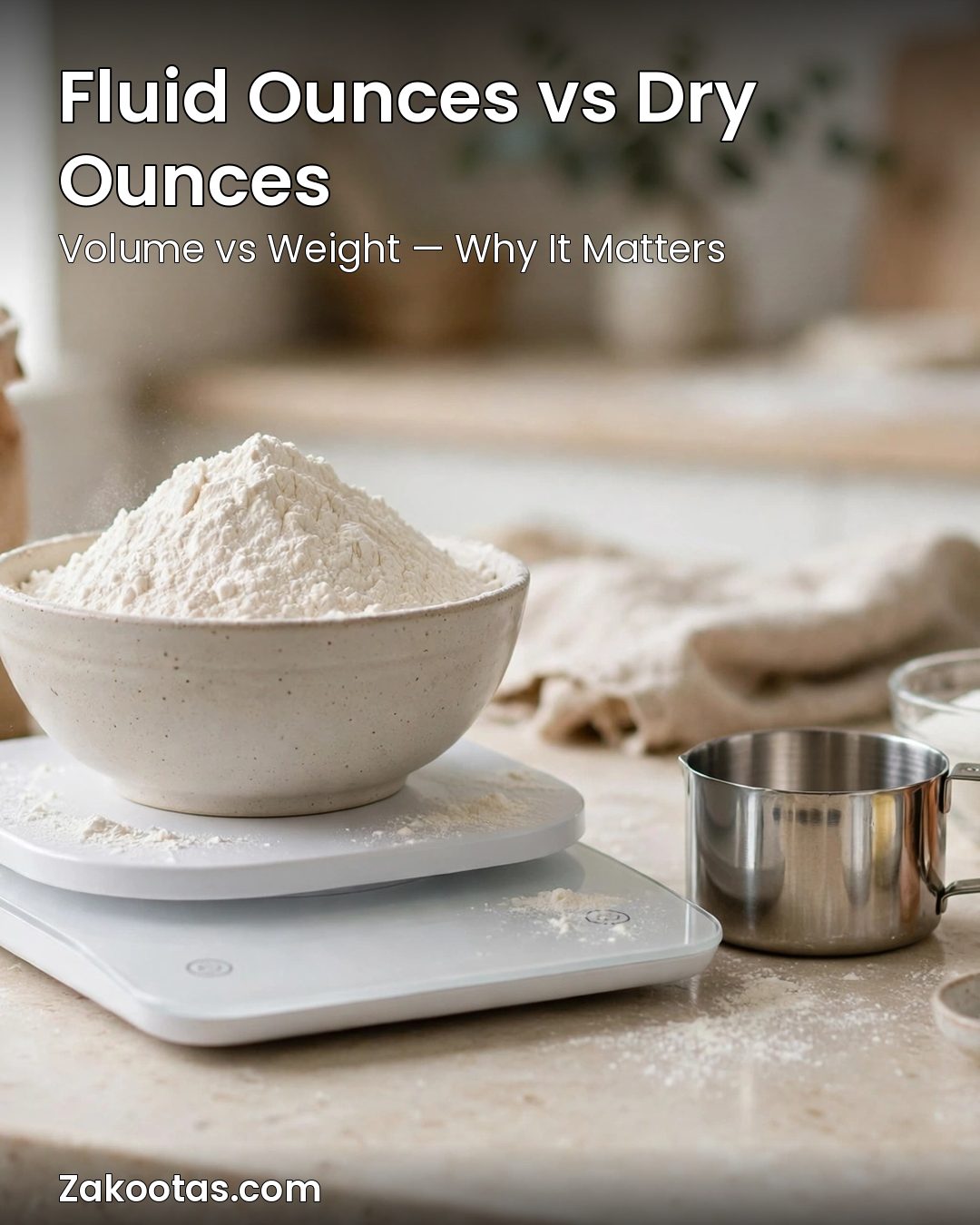
Almost every kitchen conversion mistake comes down to one confusion: fluid ounces and ounces are two different units that happen to share a name.
A fluid ounce (fl oz) measures volume — how much space something takes up. One US fluid ounce is 29.574 millilitres. A measuring jug measures fluid ounces, and 1 cup always holds 8 of them, whatever liquid you pour in.
An ounce (oz) measures weight — how heavy something is. One ounce is 28.35 grams. A kitchen scale measures ounces, and how many ounces fit in a cup depends entirely on what is in the cup. A cup of feathers would weigh almost nothing; a cup of lead would weigh a fortune. Flour, sugar and honey sit between those extremes, and each one has its own number.
The two match only for water. A cup of water is 8 fluid ounces by volume and weighs 8 ounces, because water’s density is 1 gram per millilitre. That coincidence is exactly why the confusion survives: most people first learn the rule with water, and it feels universal. It is not.
How to tell which one your recipe means: if it says “fl oz” or “fluid ounces”, it means volume — use a measuring jug. If it says “oz” on its own, especially next to a dry ingredient like flour or chocolate chips, it usually means weight — use a kitchen scale. And if a recipe just says “8 oz” for a dry ingredient, do not pour 8 fluid ounces of it. Check the chart below instead.
How Many Fluid Ounces in a Cup? (Cups to Fluid Ounces Chart)
For liquids the math is kind: multiply cups by 8. Here are the amounts you will actually reach for, including the two awkward fractions — one-third and two-thirds of a cup — where 8 does not divide evenly.
| Cups | Fluid ounces | Tablespoons | Millilitres |
|---|---|---|---|
| 1/8 cup | 1 fl oz | 2 tbsp | 30 mL |
| 1/4 cup | 2 fl oz | 4 tbsp | 59 mL |
| 1/3 cup | 2.67 fl oz | 5 tbsp + 1 tsp | 79 mL |
| 1/2 cup | 4 fl oz | 8 tbsp | 118 mL |
| 2/3 cup | 5.33 fl oz | 10 tbsp + 2 tsp | 158 mL |
| 3/4 cup | 6 fl oz | 12 tbsp | 177 mL |
| 1 cup | 8 fl oz | 16 tbsp | 237 mL |
| 1 1/2 cups | 12 fl oz | 24 tbsp | 355 mL |
| 2 cups | 16 fl oz | 32 tbsp | 473 mL |
| 4 cups (1 quart) | 32 fl oz | 64 tbsp | 946 mL |
The formula is simple either way. To turn cups into fluid ounces, multiply by 8: fluid ounces = cups × 8. To turn fluid ounces into cups, divide by 8: cups = fluid ounces ÷ 8. So 24 fluid ounces is 3 cups, and 6 fluid ounces is 3/4 of a cup.
How Many Dry Ounces in a Cup? (12-Ingredient Chart)
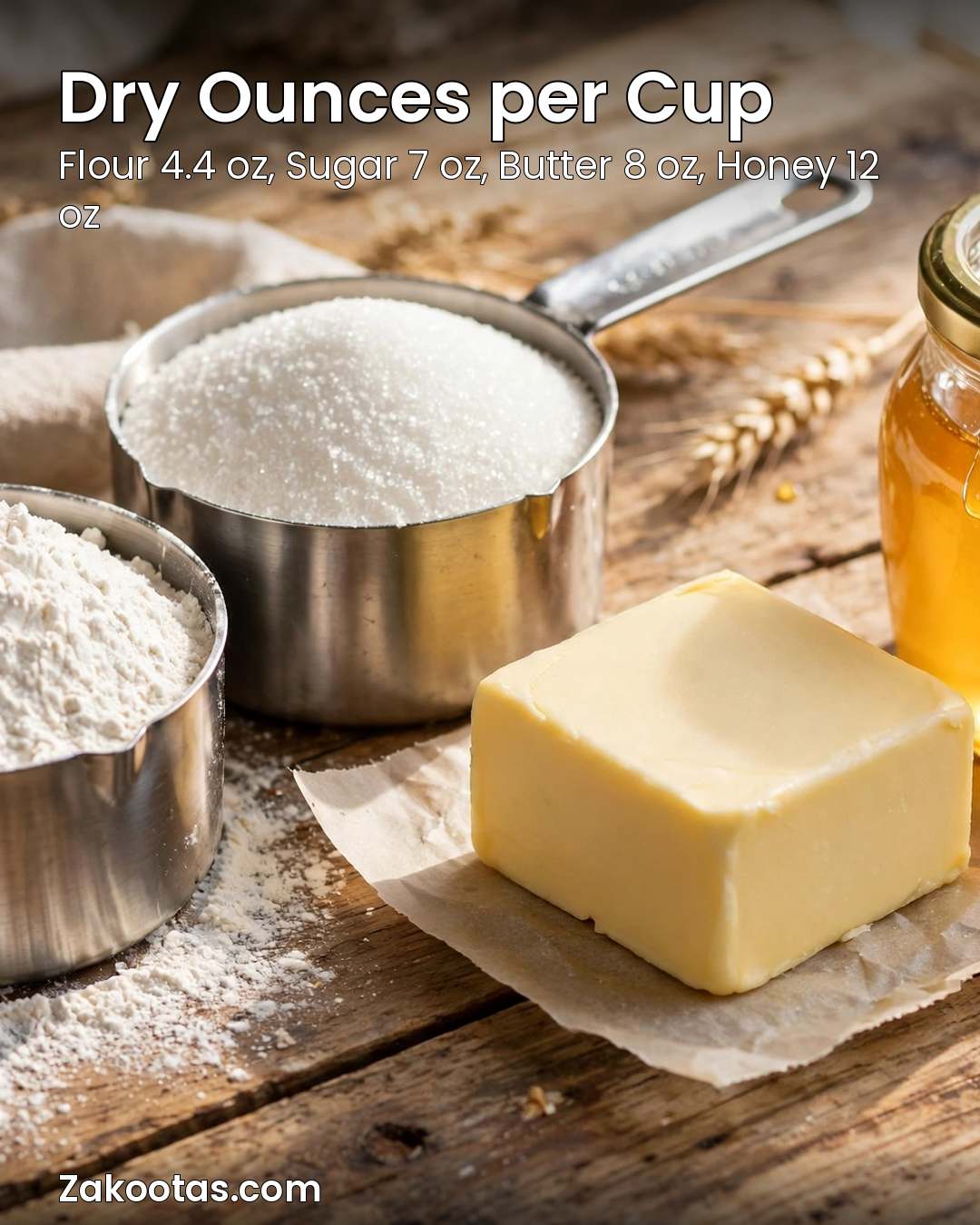
Now the part that actually saves recipes. These are the weights of a level US cup of each ingredient, measured with the spoon-and-level method for dry goods. Values are approximate — packing, humidity and brand all shift them slightly — but they are close enough to convert any recipe confidently.
| Ingredient (1 level US cup) | Weight (oz) | Weight (g) | Quick note |
|---|---|---|---|
| Water | 8 oz | 237 g | The one ingredient where cup = 8 oz matches by weight |
| Whole milk | 8.6 oz | 244 g | Slightly heavier than water |
| Butter (melted or soft) | 8 oz | 227 g | Two sticks — matches 8 oz by happy coincidence |
| Vegetable oil | 7.7 oz | 218 g | Lighter than water |
| Granulated sugar | 7.1 oz | 200 g | Dense and packs well |
| Brown sugar (packed) | 7.8 oz | 220 g | Pack it down or the number drops |
| Powdered sugar | 4.2 oz | 120 g | Mostly air — sift before measuring |
| All-purpose flour | 4.4 oz | 125 g | Spoon-and-level; scooping adds up to 20% |
| Bread flour | 4.8 oz | 137 g | Slightly heavier than all-purpose |
| Cocoa powder | 3.5 oz | 100 g | Very light — spoon it in gently |
| Rolled oats | 3.2 oz | 90 g | Lots of air between the flakes |
| Chocolate chips | 6 oz | 170 g | Gaps between chips keep the weight down |
| Long-grain rice (uncooked) | 6.5 oz | 185 g | Cooked rice weighs 2–3 times more per cup |
| Honey | 12 oz | 340 g | The heaviest common ingredient per cup |
Read the table as a warning and a tool. If a recipe calls for 8 ounces of flour and you measure a cup, you are short by almost half — you need nearly 2 cups. If it calls for 8 ounces of honey and you measure a cup, you are spot on. And if it calls for 12 ounces of flour, that is almost 3 cups, not 1 1/2. The numbers only look alike; the ingredients do not.
US Cup vs Imperial Cup vs Metric Cup
The “8 ounces in a cup” rule is an American rule. Cups are not the same size everywhere, and an old British recipe or a modern Australian one will quietly use a different cup.
| Cup standard | Size | Fluid ounces | Where it is used |
|---|---|---|---|
| US customary cup | 236.588 mL | 8 US fl oz | United States — what US recipes mean |
| US legal cup (FDA) | 240 mL | 8.12 US fl oz | Nutrition labels in the United States |
| Metric cup | 250 mL | 8.45 US fl oz | Australia, Canada, New Zealand |
| Imperial cup | 284.131 mL | 10 Imperial fl oz | Old UK recipes; an Imperial fl oz is also slightly smaller than a US one |
The gap matters more than it looks. A metric cup holds about 6% more than a US cup, so a recipe that calls for 4 metric cups of stock needs about 4 1/4 US cups — miss that and a soup comes out short. An Imperial cup is about 20% bigger than a US cup, so a British cake made with American cups ends up too dry. If a recipe comes from outside the United States, check which cup it means before you start measuring.
For the full picture of how cups relate to the other kitchen units, see our guides to how many cups are in a liter and how many cups are in a quart. And if you are converting the other way — ounces into litres — our how many ounces in a liter guide has the full table.
Ounces to Cups: The Formulas
Two formulas cover every conversion in this guide. Keep them on the fridge and you will never need a calculator mid-recipe.
- Cups to fluid ounces: fluid ounces = cups × 8. Example: 2 1/2 cups × 8 = 20 fl oz.
- Fluid ounces to cups: cups = fluid ounces ÷ 8. Example: 20 fl oz ÷ 8 = 2 1/2 cups.
- Dry ounces to cups: cups = ounces ÷ (ounces per cup from the chart above). Example: 12 oz of flour ÷ 4.4 oz per cup = about 2 3/4 cups.
- Cups to dry ounces: ounces = cups × (ounces per cup). Example: 2 cups of sugar × 7.1 oz = 14.2 oz.
For liquids the formulas are exact. For dry ingredients they are only as good as the chart value you use, so round sensibly: a recipe will not notice the difference between 2 3/4 cups and 2.73 cups of flour, but it will notice if you use the wrong ingredient’s number.
How to Measure a Cup Correctly
Getting the right number starts with the right technique. Two habits cover almost everything.
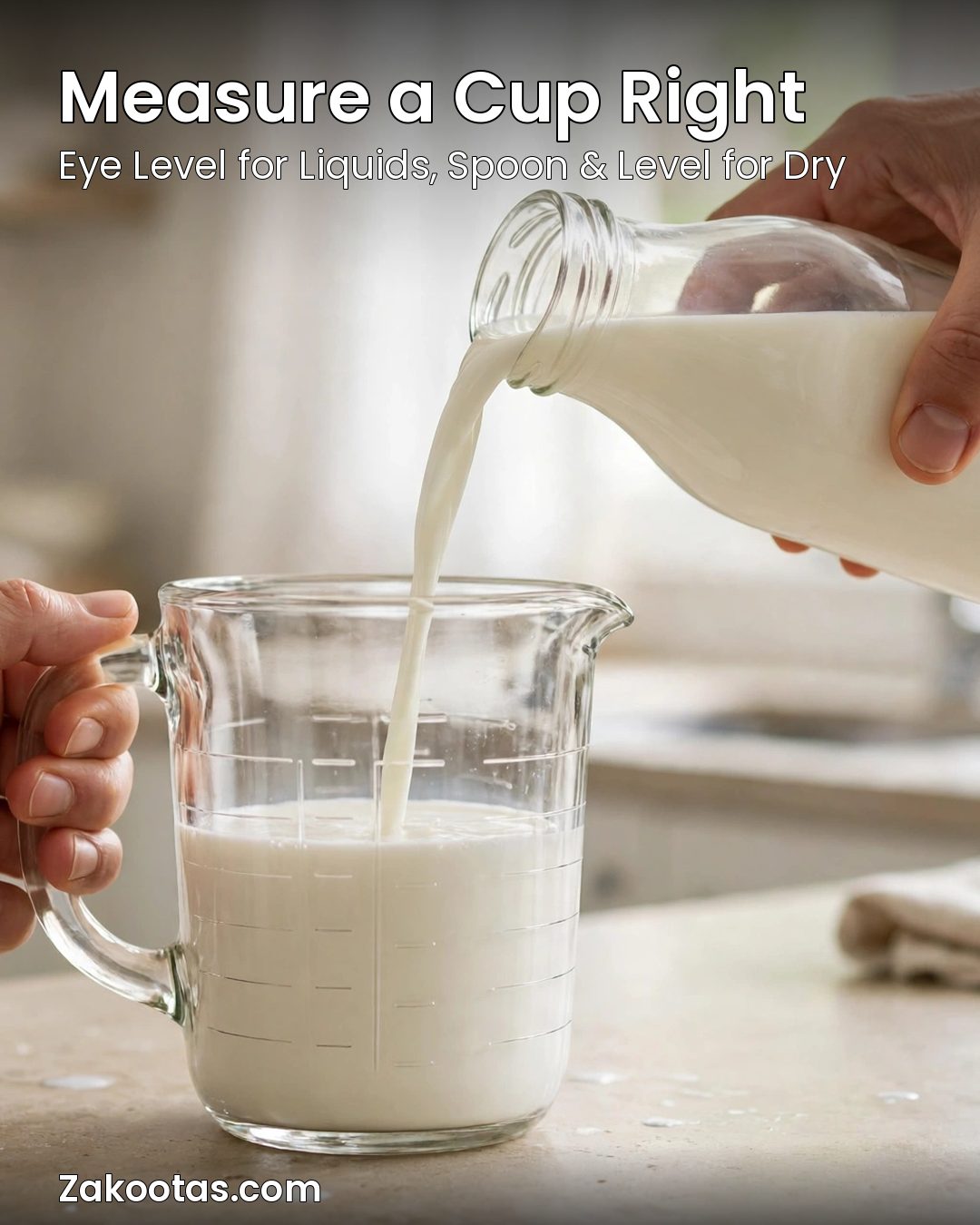
For liquids: use a clear glass measuring jug, set it on a flat surface, pour to the line, then bend down so your eyes are level with the meniscus — the curved top of the liquid. Reading from above makes the level look higher than it is, and that small error doubles when you scale a recipe up. Do not hold the jug in the air while you read it.
For dry ingredients: use the spoon-and-level method. Spoon the ingredient loosely into a dry measuring cup until it heaps above the rim, then sweep a straight knife across the top to level it off. Never scoop the cup straight out of the bag — that packs the flour down and can add 20% more weight, which is the difference between a tender cake and a brick. Brown sugar is the one exception: pack it firmly into the cup, as recipes assume it is packed.
For baking, weigh instead. A kitchen scale removes the whole problem: 120 grams of flour is 120 grams of flour no matter who measures it, while a “cup” of flour can weigh anywhere from 120 to 160 grams depending on how hard it is packed. If a recipe gives weights, use them. If it only gives cups, the dry-ounce chart above is your bridge to the scale.
Common Mistakes When Converting Cups and Ounces
- Treating “oz” and “fl oz” as the same thing. The most expensive mistake in home baking. 8 oz of flour is nearly 2 cups, not 1.
- Using a dry measuring cup for liquids. Dry cups are meant to be filled to the brim and levelled; you cannot read a liquid level in one without spilling. Use a jug with a spout.
- Scooping flour out of the bag. Packing adds up to 20% extra flour. Spoon and level, or weigh.
- Assuming a coffee mug is a cup. A standard mug holds 10–12 fluid ounces, not 8. Measure with a real cup.
- Using a US cup for a metric or Imperial recipe. A metric cup is 250 mL and an Imperial cup is 284 mL — both bigger than the 237 mL US cup.
- Forgetting the FDA legal cup. Nutrition labels use a 240 mL cup, slightly bigger than the 236.6 mL customary cup. The difference is tiny, but it explains why label math sometimes looks off by a teaspoon.
Everyday Amounts: The Cup–Ounce Ladder
Once the 8-ounce rule is in your head, the rest of the kitchen falls into place, because every step up doubles:
| Unit | Fluid ounces | Cups |
|---|---|---|
| 1 cup | 8 fl oz | 1 cup |
| 1 pint | 16 fl oz | 2 cups |
| 1 quart | 32 fl oz | 4 cups |
| 1 gallon | 128 fl oz | 16 cups |
A few everyday anchors help too. A standard can of soda is 12 fl oz, or 1 1/2 cups. A bottle of water is usually 16.9 fl oz, just over 2 cups. A typical coffee mug holds 10–12 fl oz, which is why “a cup of coffee” is not one measuring cup. And a tablespoon is 1/2 fl oz, so 2 tablespoons always equal 1 fluid ounce — the smallest step on the ladder.
Frequently Asked Questions
How many ounces in a cup?
There are 8 fluid ounces in 1 US cup for all liquids. For dry ingredients, ounces per cup vary by density: about 4.4 oz for all-purpose flour, 7.1 oz for granulated sugar, 8 oz for butter and 12 oz for honey.
Is 8 oz the same as 1 cup?
Only for liquids and for water-like ingredients. 8 fluid ounces always equals 1 cup, and 8 ounces by weight equals 1 cup only for water (and, by coincidence, butter). For flour, 8 ounces is nearly 2 cups; for honey, 8 ounces is about 2/3 of a cup.
How many fluid ounces are in 1 cup?
Exactly 8 US fluid ounces, which is 16 tablespoons, 48 teaspoons or about 237 millilitres. This is true for every liquid, because fluid ounces measure volume.
How many dry ounces are in a cup of flour?
About 4.4 ounces (125 grams) for a level cup of all-purpose flour measured with the spoon-and-level method. Scooping the cup straight from the bag packs the flour down and can raise that to 5–6 ounces.
How many ounces in half a cup?
Half a cup is 4 fluid ounces for liquids (8 tablespoons, 118 mL). By weight it depends on the ingredient: 2.2 oz of flour, 3.5 oz of sugar, 4 oz of water or butter, and 6 oz of honey.
How many ounces in a cup of sugar?
About 7.1 ounces (200 grams) for a level cup of granulated sugar. A packed cup of brown sugar weighs about 7.8 ounces, and a cup of powdered sugar weighs only about 4.2 ounces because it is mostly air.
What is the difference between fluid ounces and ounces?
Fluid ounces (fl oz) measure volume — how much space something takes up — and 1 fl oz is 29.574 mL. Ounces (oz) measure weight — how heavy something is — and 1 oz is 28.35 grams. A cup always holds 8 fluid ounces, but its weight in ounces changes with the ingredient.
How many cups is 8 ounces?
8 fluid ounces is exactly 1 cup. 8 ounces by weight is 1 cup of water or butter, about 1 3/4 cups of flour, about 1 1/8 cups of sugar, or about 2/3 of a cup of honey.
The short version to remember: 1 cup = 8 fluid ounces, always, for liquids — and for anything dry, check the chart before you pour. Keep this page bookmarked next to our liters-to-cups and cups-in-a-quart guides, and the next time a recipe says “8 oz”, you will know exactly which ounce it means.