How Many Cups in a Quart? 4 Cups + Charts, Pints, Ounces & Metric
There are 4 cups in 1 quart. That is the whole answer — but if you are mid-recipe with a quart of milk in one hand and a measuring cup in the other, you probably want more than a number. You want to know whether it is the same for a UK recipe, whether a dry quart is different, and how to scale the amount up or down without doing mental maths over a hot stove.
This guide gives you the quick answer, the full conversion charts, the US vs Imperial difference, the dry-quart trap that catches even experienced cooks, and real kitchen examples so you never have to look it up again.
Quick Answer: How Many Cups in a Quart?
1 US liquid quart = 4 US cups = 32 fluid ounces = 946.35 millilitres (about 0.95 litres). A quart is also 2 pints, and 4 quarts make 1 gallon. The rule is a simple multiply-by-four: to turn quarts into cups, multiply the number of quarts by 4. To turn cups into quarts, divide by 4.
| Quarts | Cups | Pints | Fluid Ounces | Millilitres |
|---|---|---|---|---|
| ¼ quart | 1 cup | ½ pint | 8 fl oz | 236.6 mL |
| ½ quart | 2 cups | 1 pint | 16 fl oz | 473.2 mL |
| ¾ quart | 3 cups | 1½ pints | 24 fl oz | 709.8 mL |
| 1 quart | 4 cups | 2 pints | 32 fl oz | 946.4 mL |
| 2 quarts | 8 cups | 4 pints | 64 fl oz | 1,892.7 mL |
| 3 quarts | 12 cups | 6 pints | 96 fl oz | 2,839.1 mL |
| 4 quarts | 16 cups | 8 pints | 128 fl oz | 3,785.4 mL (1 gallon) |
Why 4 Cups Make a Quart
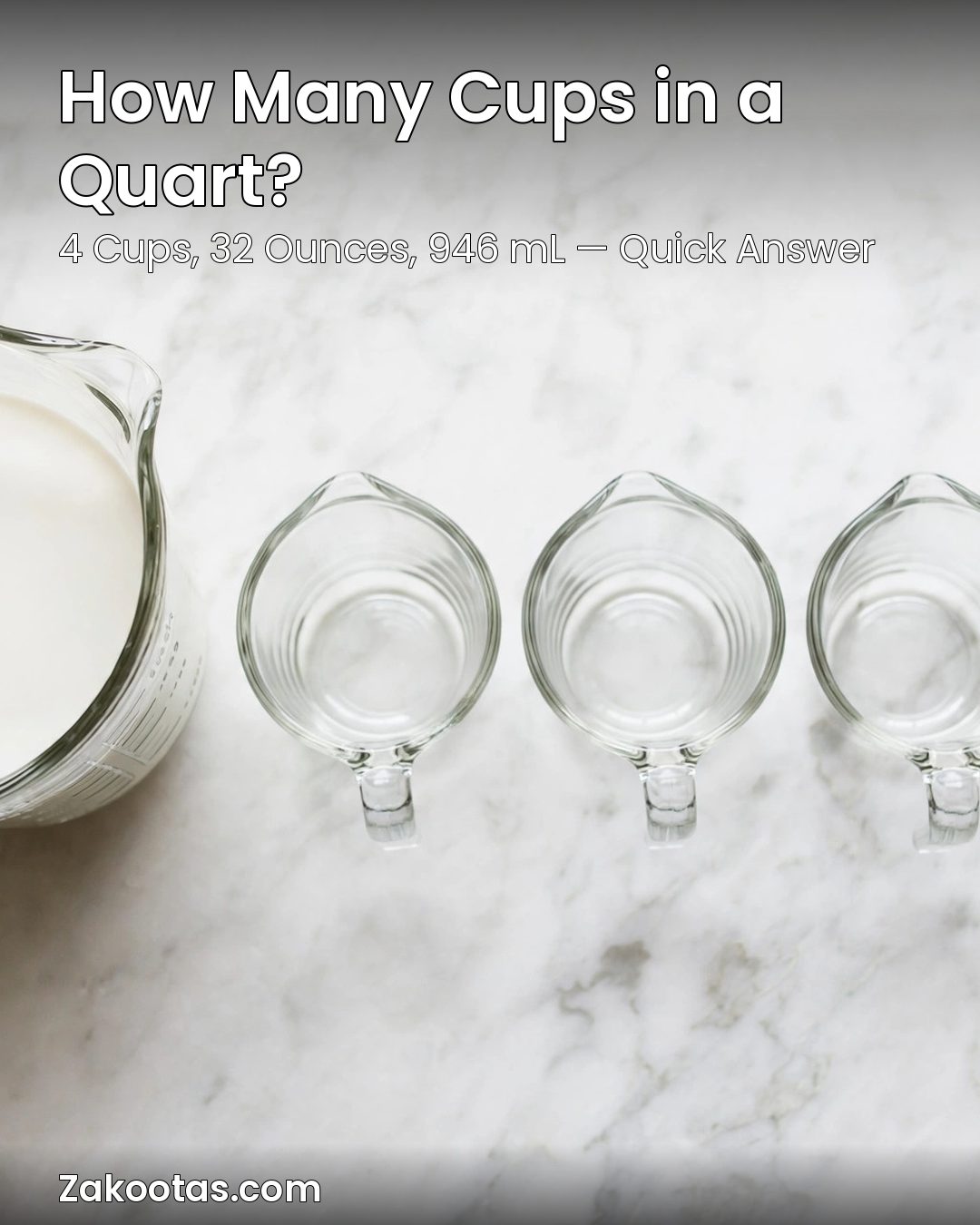
The US customary system is built on doubling, and the quart sits right in the middle of the ladder. Start with a gallon and keep cutting it in half: a gallon becomes 2 half-gallons, a half-gallon becomes a quart, a quart becomes 2 pints, and a pint becomes 2 cups. That is why the numbers are all powers of two — and why the quart-to-cup conversion is an exact 4, not an approximation.
The US National Institute of Standards and Technology (NIST Handbook 44) defines the liquid quart as exactly 57.75 cubic inches and the cup as exactly 8 fluid ounces. Since a quart holds 32 fluid ounces, 32 ÷ 8 = 4 cups. It is a defined relationship, so it never changes with the ingredient: 4 cups of water, milk, broth, or oil all fill the same quart container.
The Full US Volume Ladder
Once you know the ladder, every kitchen conversion becomes one step of doubling or halving. Here is the complete chain from gallon down to teaspoon:
| Unit | Equals | In Cups | In Fluid Ounces |
|---|---|---|---|
| 1 gallon | 4 quarts | 16 cups | 128 fl oz |
| 1 quart | 2 pints | 4 cups | 32 fl oz |
| 1 pint | 2 cups | 2 cups | 16 fl oz |
| 1 cup | 16 tablespoons | 1 cup | 8 fl oz |
| 1 fluid ounce | 2 tablespoons | ⅛ cup | 1 fl oz |
| 1 tablespoon | 3 teaspoons | 1/16 cup | ½ fl oz |
A handy way to remember it: 1 quart = 4 cups = 64 tablespoons = 192 teaspoons. If a recipe calls for a quart of stock and you only have a tablespoon measure, that is the number — though we would not recommend counting to 64.
How to Convert Quarts to Cups (and Back)
There are only two formulas to remember, and they are mirror images of each other:
- Quarts to cups: multiply by 4. Cups = quarts × 4. So 1.5 quarts × 4 = 6 cups.
- Cups to quarts: divide by 4. Quarts = cups ÷ 4. So 10 cups ÷ 4 = 2.5 quarts.
Quarts to Cups Conversion Table
| Quarts | Cups | Fluid Ounces | Millilitres |
|---|---|---|---|
| ⅛ quart | ½ cup | 4 fl oz | 118.3 mL |
| ¼ quart | 1 cup | 8 fl oz | 236.6 mL |
| ⅓ quart | 1⅓ cups | 10.7 fl oz | 315.5 mL |
| ½ quart | 2 cups | 16 fl oz | 473.2 mL |
| ⅔ quart | 2⅔ cups | 21.3 fl oz | 630.9 mL |
| ¾ quart | 3 cups | 24 fl oz | 709.8 mL |
| 1 quart | 4 cups | 32 fl oz | 946.4 mL |
| 1½ quarts | 6 cups | 48 fl oz | 1,419.5 mL |
| 2 quarts | 8 cups | 64 fl oz | 1,892.7 mL |
| 2½ quarts | 10 cups | 80 fl oz | 2,365.9 mL |
| 3 quarts | 12 cups | 96 fl oz | 2,839.1 mL |
| 4 quarts | 16 cups | 128 fl oz | 3,785.4 mL |
| 5 quarts | 20 cups | 160 fl oz | 4,731.8 mL |
| 8 quarts | 32 cups | 256 fl oz | 7,570.8 mL (2 gallons) |
Cups to Quarts Conversion Table
| Cups | Quarts | Pints |
|---|---|---|
| 1 cup | ¼ quart | ½ pint |
| 2 cups | ½ quart | 1 pint |
| 3 cups | ¾ quart | 1½ pints |
| 4 cups | 1 quart | 2 pints |
| 6 cups | 1½ quarts | 3 pints |
| 8 cups | 2 quarts | 4 pints |
| 12 cups | 3 quarts | 6 pints |
| 16 cups | 4 quarts (1 gallon) | 8 pints |
US Quart vs Imperial Quart: Not the Same
This is the conversion that ruins recipes. The United States and the United Kingdom both use the word “quart”, but they mean different volumes. A US liquid quart is 946.35 mL; an Imperial (UK) quart is 1,136.52 mL — about 20% larger. In US cups, an Imperial quart is roughly 4.8 cups, not 4.
| US Liquid Quart | Imperial (UK) Quart | |
|---|---|---|
| Millilitres | 946.35 mL | 1,136.52 mL |
| Fluid ounces | 32 US fl oz | 40 Imperial fl oz |
| US cups | 4 cups | ≈ 4.8 cups |
| Pints | 2 US pints | 2 Imperial pints |
| Used in | USA, modern recipes | UK, older/Commonwealth recipes |
If you follow a British recipe that calls for a quart of milk and measure out 4 US cups, you will be nearly a cup short. The fix is simple: for an Imperial quart, use 4¾ cups (plus a splash), or measure 1,137 mL on a metric jug. Most recipes written after about 1970 in the UK use metric anyway, so this mostly matters for vintage cookbooks and older family recipes.
Dry Quart vs Liquid Quart: The Trap
There is a second kind of quart that trips people up. The US dry quart is a different, larger measure used for dry goods like berries and grain. It is defined as 67.2 cubic inches, while the liquid quart is 57.75 cubic inches — so a dry quart is about 16% bigger than a liquid quart.
Here is the important part: the 4-cup rule does not apply to dry quarts. Dry quarts are not normally converted into cups at all; the dry system has its own ladder (2 dry pints = 1 dry quart, 8 dry quarts = 1 peck, 4 pecks = 1 bushel). When a recipe says “1 quart of strawberries”, it almost always means a volume measured in a liquid quart container or simply the standard berry basket sold as a quart — in practice, that is about 4 cups of berries. But if you are doing a precise dry-goods conversion, do not use the 4-cup figure.
Two quick rules to stay safe:
- Liquids and recipes: 1 quart = 4 cups. Always.
- Dry bulk goods (berries, grain, produce): use the container labelled as a quart, or weigh the ingredient — do not convert a dry quart to cups.
How Many Cups in a Quart in the Kitchen: Real Examples
Conversions are easier to remember when they are attached to things you actually hold. Here are the quart-sized containers you meet every week:
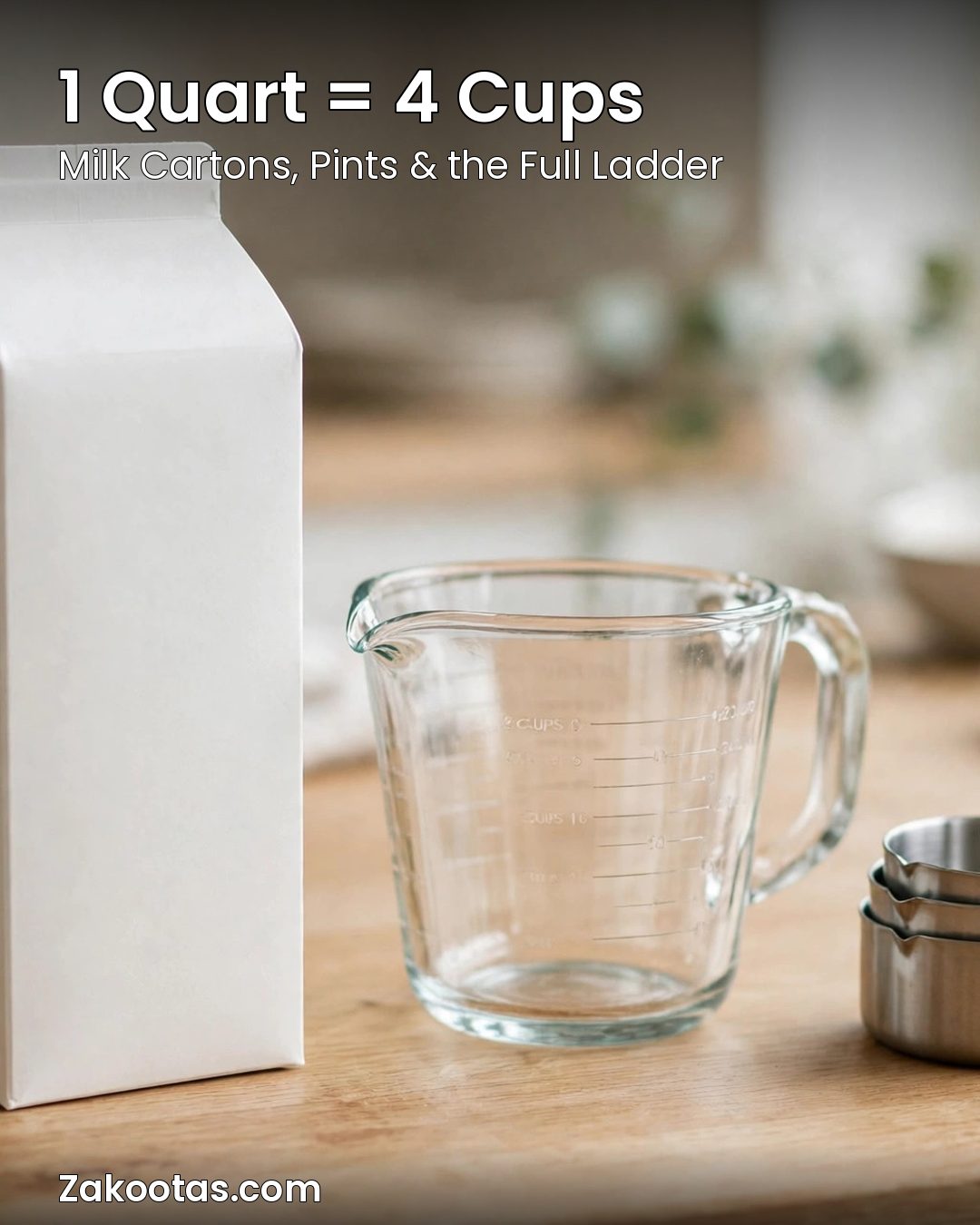
- A standard milk carton — the familiar half-gallon jug in the fridge is 2 quarts (8 cups). The smaller quart carton is exactly 4 cups.
- A 32-ounce soup container — takeaway soup tubs and deli containers marked 32 oz hold exactly 1 quart, or 4 cups.
- A 2-quart pitcher — the usual jug for iced tea or lemonade holds 8 cups. Fill it twice and you have a gallon.
- A quart of ice cream — the tub labelled 1 quart contains 4 cups of ice cream, or about 8 half-cup servings.
- A large yoghurt tub — the 32 oz family tub is 1 quart, so 4 cups.
- A slow-cooker recipe — a recipe that calls for 2 quarts of stock needs 8 cups, which is two standard 4-cup (32 oz) cartons of broth.
Measuring a Quart Correctly
A conversion is only as good as the measuring. A few habits keep your quart accurate:
- Use a liquid measuring jug for liquids. Fill to the 4-cup / 32 oz line at eye level, on a flat surface — not held up in the air.
- Use dry measuring cups for dry ingredients. Spoon flour or sugar in, then level it off with a knife. Scooping packs it down and adds up to 20% extra.
- Do not use a coffee mug as a cup. Mugs hold anywhere from 8 to 16 ounces. A standard measuring cup is exactly 8 fluid ounces.
- Know which cup your recipe means. A US customary cup is 236.6 mL, the “legal” cup used on US nutrition labels is 240 mL, and a metric cup (Australia, New Zealand, Canada) is 250 mL. For a single quart the difference is small — about ⅔ of a tablespoon per cup — but across a big batch it adds up.
- When scaling a recipe, convert first, then multiply. Doubling a recipe that calls for 3 quarts? That is 12 cups; double it to 24 cups, or 6 quarts — one clean number instead of a string of fractions.
Common Mistakes When Converting Quarts to Cups
- Thinking 1 quart is 6 cups. It is not. The confusion usually comes from mixing up quarts with pints (2 cups) and gallons (16 cups). One quart is 4 cups — always, for liquids.
- Using an Imperial quart as 4 cups. An Imperial quart is about 4.8 US cups. In a baking recipe, that missing ¾ cup can change the result.
- Applying the 4-cup rule to a dry quart. Dry quarts are bigger and belong to a different system.
- Confusing fluid ounces with weight ounces. A cup of water weighs about 8 ounces, but a cup of flour weighs about 4.25 ounces. Fluid ounces measure volume; weight ounces measure mass. For liquids they line up; for dry ingredients they do not.
- Guessing with a mug or glass. Kitchen glasses vary wildly. One measuring cup is the only reliable “cup”.
How Many Cups in a Gallon, Pint, and Other Units?
The quart is one step on a ladder you will use constantly. If you are scaling recipes, these companion conversions help — and Zakootas already has full guides for two of them:
- How many cups in a gallon? — 16 cups in 1 US gallon (4 quarts). The full gallon guide with charts.
- How many ounces in a liter? — 33.8 US fluid ounces in 1 liter, with the full metric-to-US conversion tables.
- How many cups in a pint? — 2 cups in 1 pint. A pint is half a quart.
- How many cups in a half gallon? — 8 cups. A half gallon is 2 quarts.
- How many tablespoons in a quart? — 64 tablespoons (16 per cup × 4 cups).
- How many teaspoons in a quart? — 192 teaspoons (48 per cup × 4 cups).
Frequently Asked Questions
How many cups are in 1 quart?
There are exactly 4 cups in 1 US liquid quart. That is also 2 pints, 32 fluid ounces, or 946.35 millilitres.
Is 1 quart 4 cups or 6 cups?
1 quart is 4 cups, not 6. The number 6 usually comes from confusing quarts with other units — a gallon has 16 cups and a half-gallon has 8, but a quart is always 4 cups in the US system.
How many cups in 2 quarts?
There are 8 cups in 2 quarts. Multiply the quarts by 4: 2 × 4 = 8 cups (64 fluid ounces, about 1.89 litres).
How many cups in 3 quarts?
There are 12 cups in 3 quarts. Multiply by 4: 3 × 4 = 12 cups (96 fluid ounces, about 2.84 litres).
How many cups in a UK quart?
An Imperial (UK) quart is about 4.8 US cups, because it holds 1,136.52 mL compared with 946.35 mL for a US quart. If a British recipe calls for a quart, use 4¾ cups, or measure 1,137 mL.
Is a dry quart the same as a liquid quart?
No. A US dry quart (67.2 cubic inches) is about 16% larger than a US liquid quart (57.75 cubic inches), and dry quarts are not converted into cups. The 4-cup rule applies to liquid quarts only.
How many ounces are in a quart?
There are 32 fluid ounces in 1 US liquid quart. An Imperial quart has 40 Imperial fluid ounces. In millilitres, a US quart is 946.35 mL and an Imperial quart is 1,136.52 mL.
How do I convert quarts to cups?
Multiply the number of quarts by 4. For example, 1.5 quarts × 4 = 6 cups. To convert cups back to quarts, divide by 4 — for example, 10 cups ÷ 4 = 2.5 quarts.
The Short Version
One quart is four cups. It is two pints, 32 fluid ounces, and just under a litre. Multiply quarts by 4 to get cups, divide cups by 4 to get quarts, and watch out for the two exceptions — the Imperial quart (about 4.8 US cups) and the dry quart (a different, larger measure). Keep the ladder in mind — gallon, quart, pint, cup — and you will never need to look this up mid-recipe again.