How Many Cups in a Liter? 4.23 Cups + Charts, Metric & US Cups
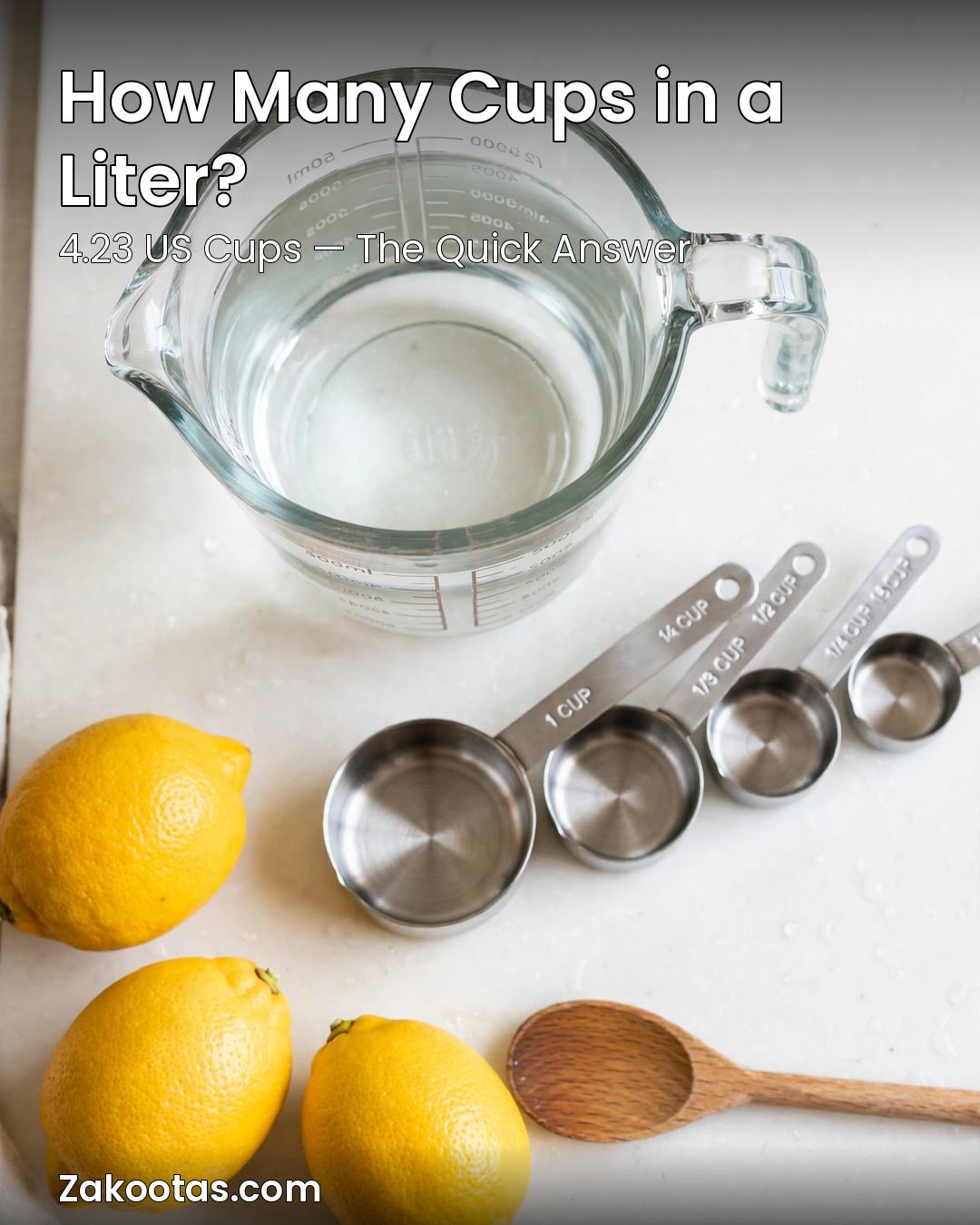
There are 4.23 US cups in 1 liter — or exactly 4 cups if you are using a metric cup. That is the whole answer, but it comes with a catch that has ruined plenty of recipes: a “cup” is not the same size everywhere. The American measuring cup holds 236.6 millilitres, while the metric cup used in Australia, Canada and New Zealand holds exactly 250 millilitres. Use the wrong one and your litre of soup stock comes out short by more than half a cup.
This guide gives you the quick answer, the full liters-to-cups conversion charts, the difference between US, metric, legal and Imperial cups, and the kitchen shortcuts that work when you do not have a calculator handy. If you have ever stared at a European recipe that calls for a litre of milk and wondered how many cups that really is, this is the page to bookmark.
Quick Answer: How Many Cups in a Liter?
1 liter = 4.22675 US cups, which you can round to 4.23 cups or, for everyday cooking, 4¼ cups. In the metric system the answer is a clean 4 metric cups, because each metric cup is exactly 250 mL and a liter is exactly 1,000 mL. A liter is also 33.81 US fluid ounces, 2.11 pints, 1.06 quarts and 0.26 gallons.
| Liters | US Cups | Metric Cups | Fluid Ounces | Millilitres |
|---|---|---|---|---|
| ¼ liter | 1.06 cups | 1 cup | 8.45 fl oz | 250 mL |
| ½ liter | 2.11 cups | 2 cups | 16.91 fl oz | 500 mL |
| ¾ liter | 3.17 cups | 3 cups | 25.36 fl oz | 750 mL |
| 1 liter | 4.23 cups | 4 cups | 33.81 fl oz | 1,000 mL |
| 1.5 liters | 6.34 cups | 6 cups | 50.72 fl oz | 1,500 mL |
| 2 liters | 8.45 cups | 8 cups | 67.63 fl oz | 2,000 mL |
| 3 liters | 12.68 cups | 12 cups | 101.44 fl oz | 3,000 mL |
| 4 liters | 16.91 cups | 16 cups | 135.26 fl oz | 4,000 mL |
Why the Answer Is Not a Round Number
The awkward decimal comes from the fact that the liter and the cup were invented by two different systems. A liter is a metric unit, defined as exactly 1,000 cubic centimetres. A US customary cup is defined as 8 fluid ounces, or 236.588 millilitres. Divide 1,000 by 236.588 and you get 4.22675 — the number that refuses to round neatly.
That is why most conversion charts show 4.23 cups per liter, while cookbooks that value simplicity tell you to use 4¼ cups. The difference between 4.23 and 4.25 cups is less than a teaspoon per liter, so for almost every recipe the rounded figure is perfectly fine. Where the rounding does matter is when you scale up: four liters measured as 16 cups instead of 16.91 cups leaves you nearly a full cup short. Batch cooking is where the extra quarter-cup per liter adds up.
The other reason the answer feels slippery is that not every cup is a US cup. Before you convert, you need to know which cup your recipe means — and that depends on where the recipe comes from.
US Cup vs Metric Cup vs Legal Cup vs Imperial Cup
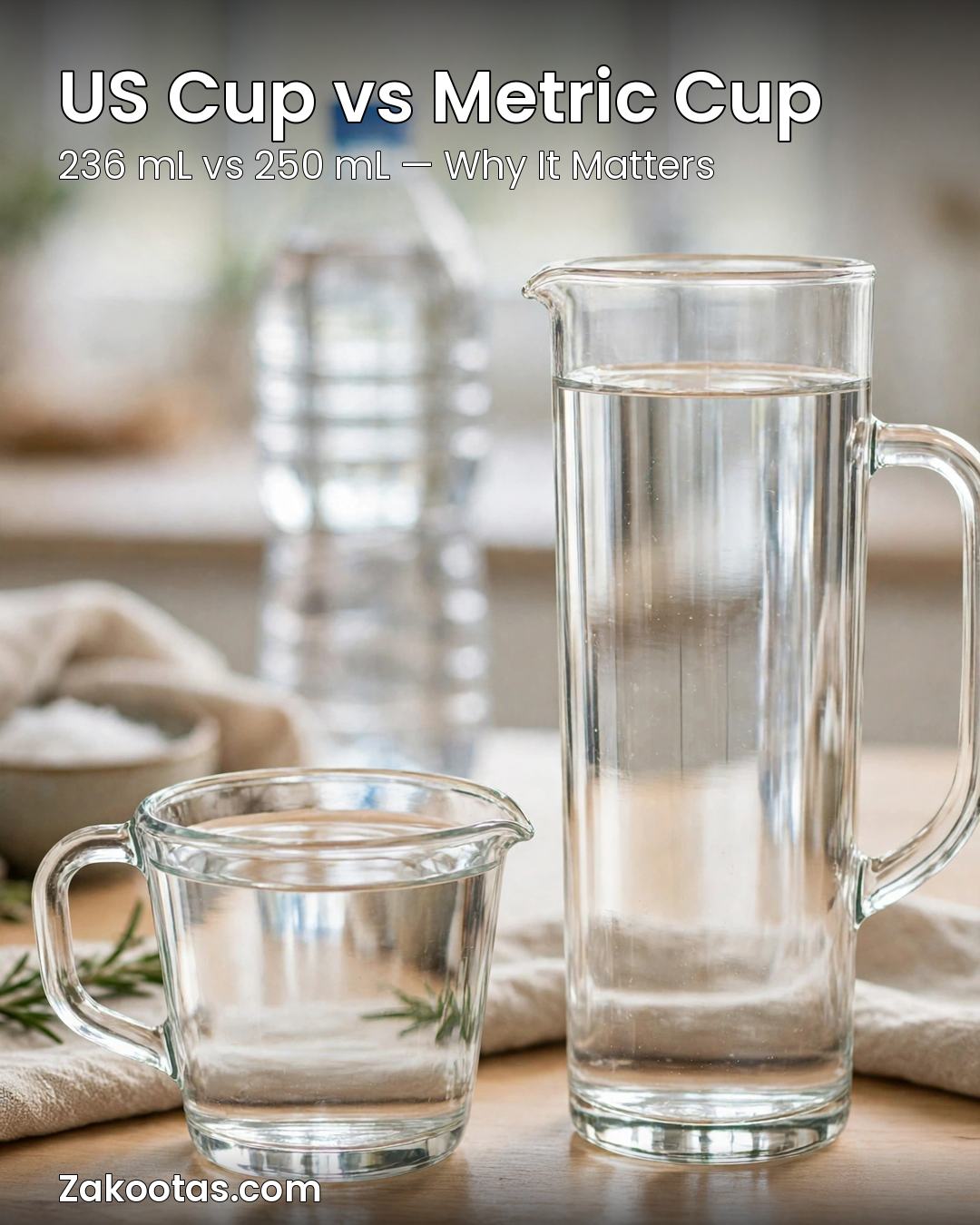
Four different cups are in common use, and they hold four different volumes. A US customary cup — the one in American kitchens — holds 236.588 mL. A metric cup, standard in Australia, New Zealand, Canada and much of the world, holds exactly 250 mL. A US legal cup, the one the FDA uses for Nutrition Facts labels, holds 240 mL. And the old British Imperial cup, still found in some older UK cookbooks, holds 284.131 mL.
| Cup standard | Size of 1 cup | Cups in 1 liter | Where it is used |
|---|---|---|---|
| US customary cup | 236.588 mL | 4.23 cups | American recipes and measuring cups |
| Metric cup | 250 mL | 4 cups exactly | Australia, New Zealand, Canada, Europe |
| US legal cup | 240 mL | 4.17 cups | US Nutrition Facts labels |
| Imperial cup | 284.131 mL | 3.52 cups | Older British recipes |
For most American home cooks, the US customary cup is the right one: 1 liter = 4.23 US cups. If your recipe is Australian or European, it almost certainly means metric cups, and the answer is a clean 4 cups per liter. If you are reading a nutrition label, the legal cup gives 4.17 cups. The Imperial cup is the one to watch for in old British cookbooks — a liter is only 3.52 of those, so mistaking an Imperial cup for a US cup will over-measure by about 20%.
The practical rule is simple: check the origin of the recipe first, then pick the row that matches. When in doubt, the metric cup is the safest assumption for any recipe written outside the United States.
Liters to Cups Conversion Chart
These are the amounts you will actually reach for. All values use the US customary cup (236.588 mL), rounded to two decimal places, with the handy kitchen rounding in the last column.
| Liters | US Cups (exact) | Kitchen shortcut | Metric cups |
|---|---|---|---|
| 0.25 L | 1.06 cups | 1 cup + 1 tbsp | 1 cup |
| 0.5 L | 2.11 cups | 2 cups + 2 tbsp | 2 cups |
| 0.75 L | 3.17 cups | 3 cups + 3 tbsp | 3 cups |
| 1 L | 4.23 cups | 4 cups + ¼ cup | 4 cups |
| 1.25 L | 5.28 cups | 5 cups + ¼ cup | 5 cups |
| 1.5 L | 6.34 cups | 6 cups + ⅓ cup | 6 cups |
| 2 L | 8.45 cups | 8 cups + ½ cup | 8 cups |
| 2.5 L | 10.57 cups | 10 cups + ½ cup | 10 cups |
| 3 L | 12.68 cups | 12 cups + ⅔ cup | 12 cups |
| 4 L | 16.91 cups | 17 cups (approx.) | 16 cups |
| 5 L | 21.13 cups | 21 cups | 20 cups |
Cups to Liters: The Reverse Conversion
Sometimes the recipe runs the other way — you have cups and need liters. The formula is the mirror image: liters = cups × 0.236588. So 1 US cup is 0.2366 liters, 4 cups is 0.946 liters (just under a liter), and 8 cups is 1.893 liters. A quick mental shortcut: 4 cups is almost exactly 1 liter, short by about 54 mL, or roughly 3½ tablespoons. That is why cooks often say “4 cups ≈ 1 liter” — it is close enough for soups, stews and drinks, though not for precise baking.
| US Cups | Liters | Millilitres |
|---|---|---|
| 1 cup | 0.237 L | 236.6 mL |
| 2 cups | 0.473 L | 473.2 mL |
| 3 cups | 0.710 L | 709.8 mL |
| 4 cups | 0.946 L | 946.4 mL |
| 6 cups | 1.419 L | 1,419.5 mL |
| 8 cups | 1.893 L | 1,892.7 mL |
| 12 cups | 2.839 L | 2,839.1 mL |
| 16 cups | 3.785 L | 3,785.4 mL |
If you already know the quart conversions, this fits the same ladder: 1 liter is 1.057 quarts, so it is just over a quart — about 4 cups plus a quarter cup. Our guide to how many cups are in a quart covers the quart side of the ladder in detail, and our ounces in a liter guide gives the fluid-ounce version of the same answer.
How to Convert Liters to Cups (The Formula)
The formula is one multiplication: cups = liters × 4.22675. Multiply the number of liters by 4.22675 and you have the number of US cups. For 1.5 liters that is 1.5 × 4.22675 = 6.34 cups. For 2 liters it is 2 × 4.22675 = 8.45 cups. For a quick estimate in your head, multiply by 4 and then add a quarter cup for every liter — 2 liters is 8 cups plus half a cup, which is 8.5 cups, only a tablespoon off the exact 8.45.
Going the other way, divide cups by 4.22675, or multiply cups by 0.236588. A calculator is nice, but the “multiply by 4, add a quarter cup per liter” trick will get you through any recipe without one.
Common Liter Amounts in Everyday Life
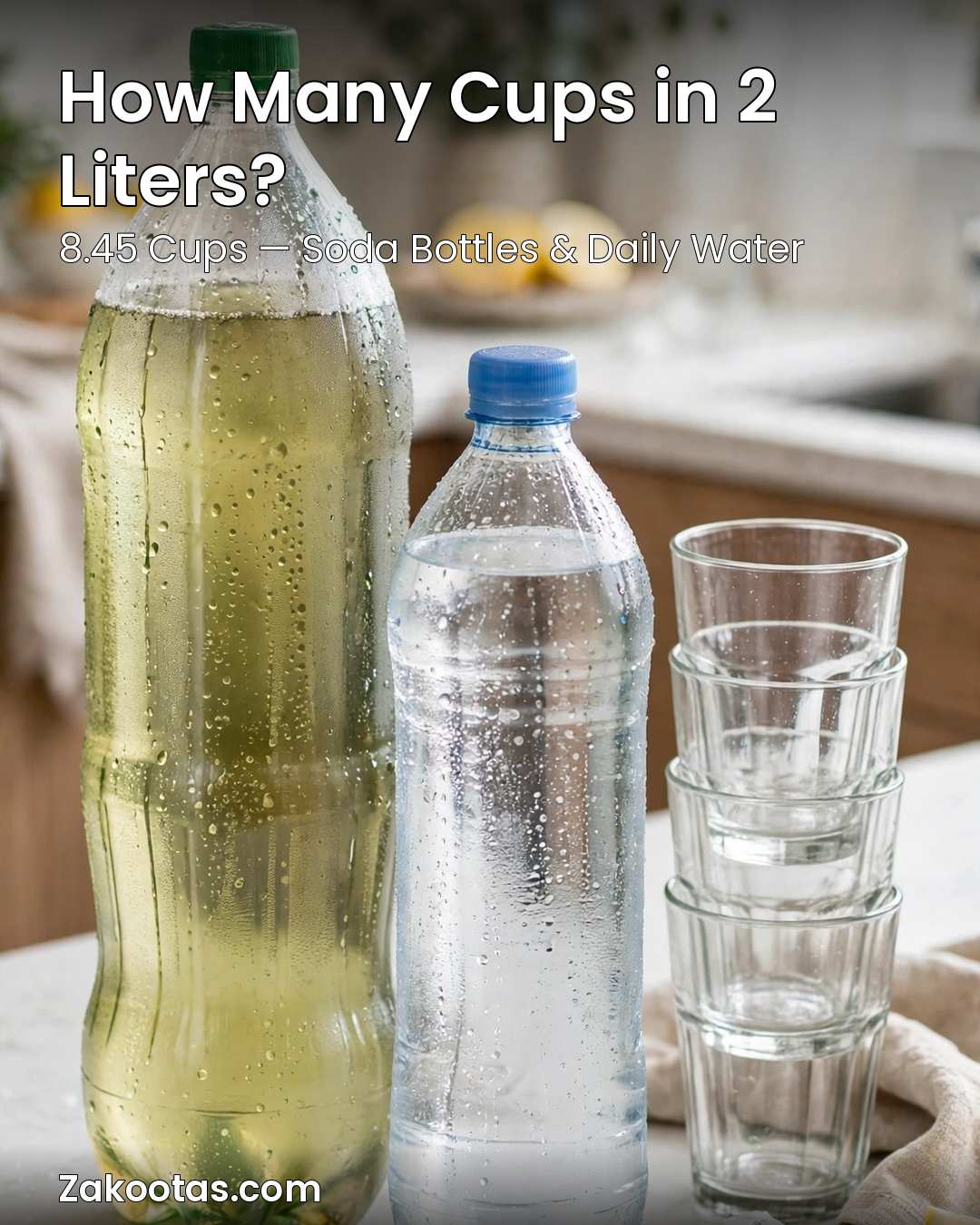
Liters show up in places you might not think of as “metric.” A standard bottle of soda is 2 liters — that is 8.45 US cups, or about 8½ cups. A carton of milk or juice is often 1 liter, which is 4.23 cups. A large bottle of water is usually 1.5 liters, or 6.34 cups. Wine comes in 750 mL bottles, which is 0.75 liters or 3.17 cups, and a magnum is 1.5 liters.
The amounts matter beyond the kitchen, too. Daily water-intake guidance is often given in liters — 2 liters a day is roughly 8½ cups, and 3 liters is about 12.7 cups. If your water bottle is marked in liters and your tracking app counts cups, the 4.23 multiplier is the bridge between the two.
How Many Cups in 2 Liters? (And Other Popular Amounts)
Two liters is the amount people search for most after one liter, because it is the size of a soda bottle and a common daily water target. 2 liters = 8.45 US cups, or exactly 8 metric cups. Round it to 8½ cups in the kitchen and you will be within a tablespoon of exact.
- 0.5 liters = 2.11 US cups (about 2 cups + 2 tablespoons)
- 1 liter = 4.23 US cups (about 4¼ cups)
- 1.5 liters = 6.34 US cups (about 6⅓ cups)
- 2 liters = 8.45 US cups (about 8½ cups)
- 3 liters = 12.68 US cups (about 12⅔ cups)
- 4 liters = 16.91 US cups (about 17 cups — just over a gallon)
- 5 liters = 21.13 US cups (about 21 cups)
Note that 4 liters is 16.91 cups, just over the 16 cups in a US gallon — so a 4-liter jug is slightly bigger than a gallon. Our guide to how many cups are in a gallon lays out the full gallon ladder if you need it.
Measuring a Liter Correctly in the Kitchen
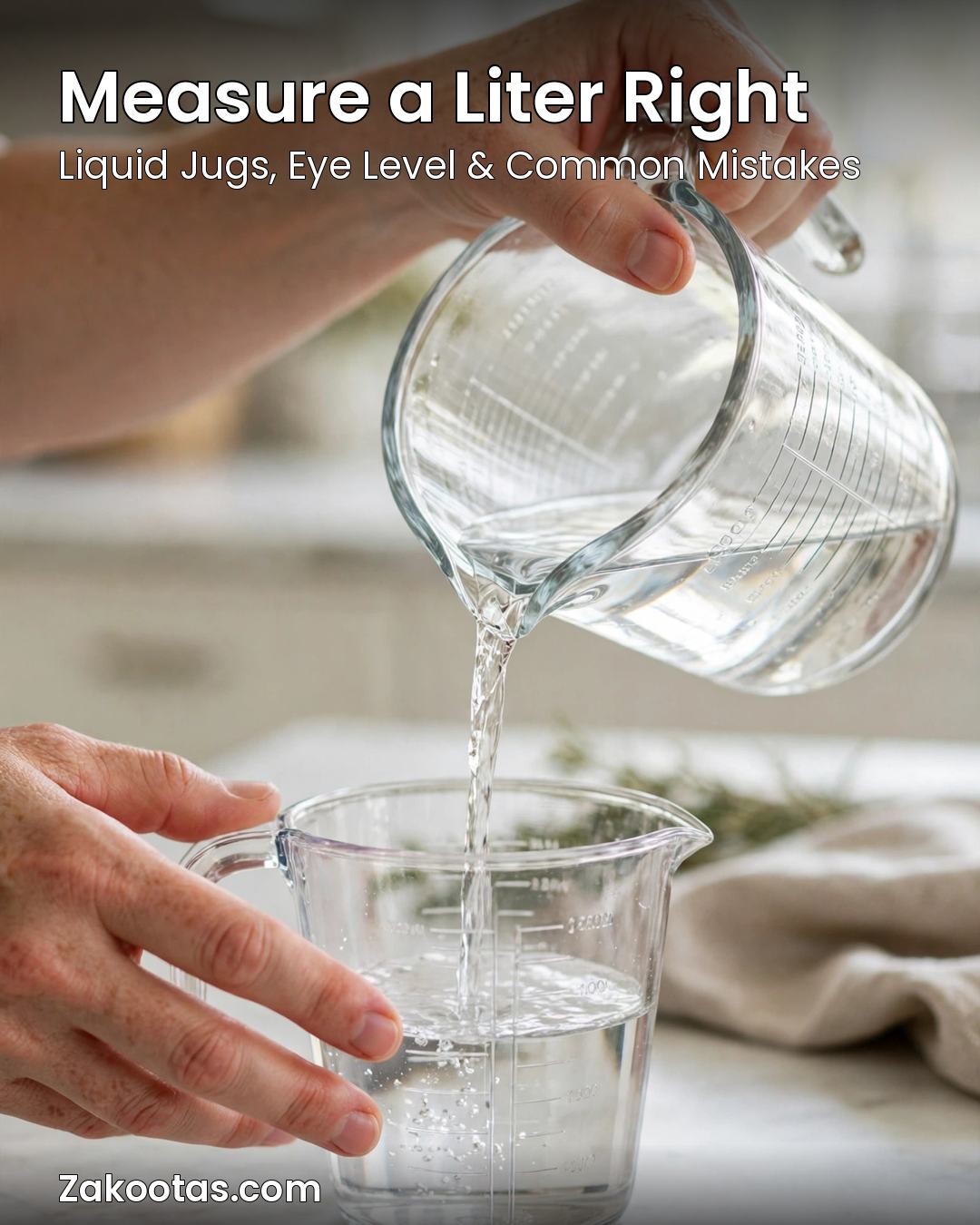
The conversion only helps if the measuring is right. Three mistakes cause most errors. First, measuring in a dry measuring cup: liquid measures have a spout and headroom so you can fill to the line at eye level; dry cups are meant to be levelled off with a knife, and using one for liquids invites spills and under-measuring. Second, reading the meniscus from above: the surface of a liquid curves, so crouch down and read the bottom of the curve at eye level, not from a standing angle. Third, measuring milk or stock in a cup meant for flour: flour packs down and needs levelling, while liquids need a pour-to-the-line.
For baking, where the extra quarter cup per liter genuinely matters, weigh instead of measuring by volume when you can: 1 liter of water weighs exactly 1 kilogram, and a kitchen scale removes the cup question entirely. For soups, sauces and drinks, the 4¼-cups shortcut is more than accurate enough.
Does the Liquid Matter? Water, Milk, Oil and Flour
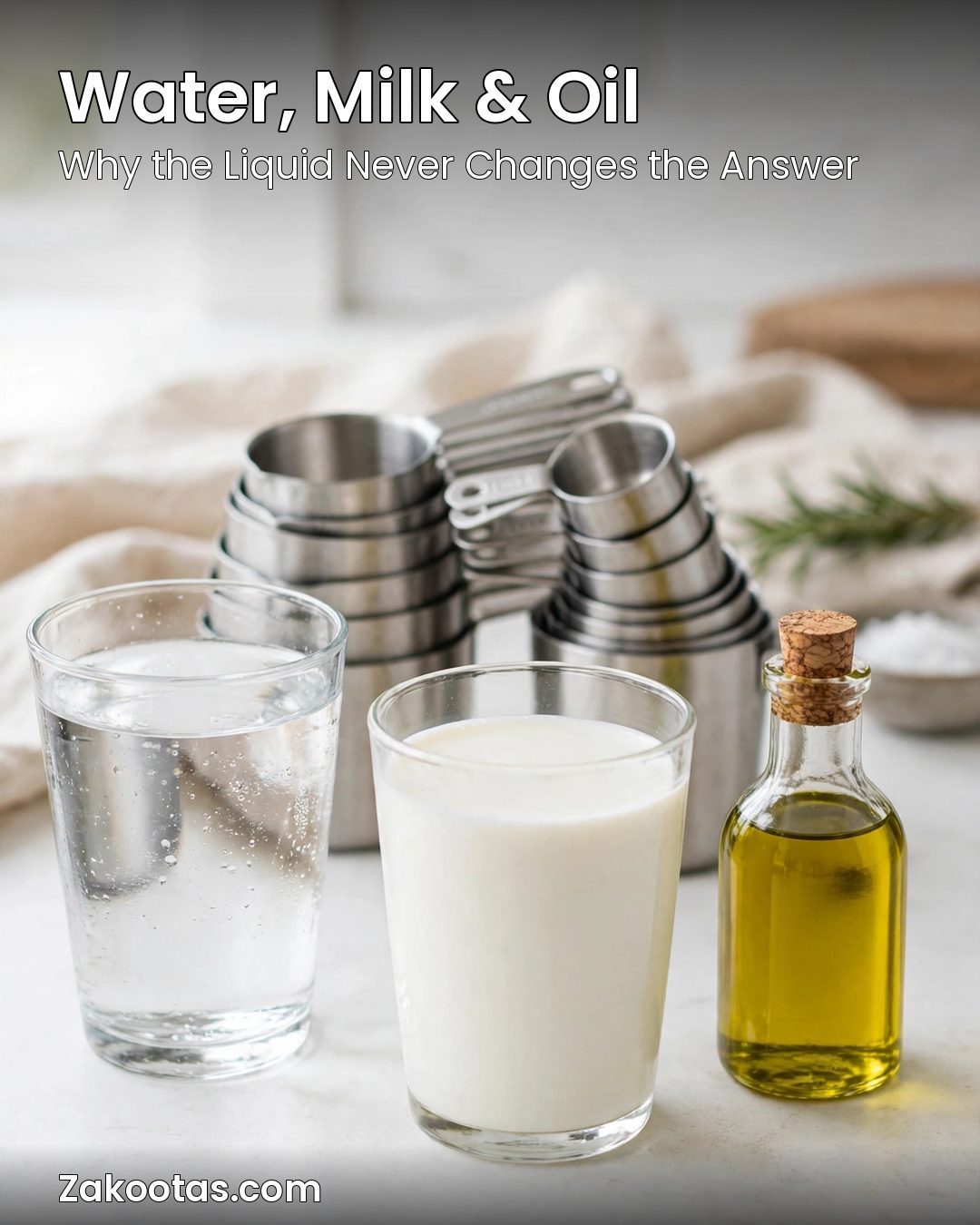
For liquids, the answer never changes: a liter of water, milk, juice, oil or wine is always 4.23 US cups, because cups and liters both measure volume. What changes is weight — a liter of oil weighs less than a liter of water — but the volume is identical. So the “how many cups in a liter of water” question has the same answer as “how many cups in a liter of milk”: 4.23 cups.
Dry ingredients are a different story. A liter of flour does not weigh the same as a liter of sugar, and scooping flour into a cup packs it differently every time. That is why bakers weigh dry ingredients in grams: volume conversions for dry goods are approximate at best. If a recipe gives flour in liters, convert to cups only as a rough guide (about 4.23 cups) and expect to adjust by feel — or better, use a scale.
Liter vs Quart vs Gallon: The Quick Ladder
The liter sits just above the quart on the volume ladder, which is handy if you already think in quarts and gallons. One liter is 1.057 US quarts, 2.11 pints, 33.81 fluid ounces and 0.264 US gallons. Flip it around: a US quart is 0.946 liters, a pint is 0.473 liters, and a gallon is 3.785 liters. If you can remember that a liter is “a quart plus a splash,” you will never be far wrong in the kitchen.
| Unit | Equals in liters | Equals in US cups |
|---|---|---|
| 1 US cup | 0.237 L | 1 cup |
| 1 pint | 0.473 L | 2 cups |
| 1 quart | 0.946 L | 4 cups |
| 1 liter | 1 L | 4.23 cups |
| 1 gallon | 3.785 L | 16 cups |
Frequently Asked Questions
How many cups are in 1 liter?
There are 4.23 US cups in 1 liter (4.22675 cups exactly). If you are using metric cups, which hold 250 mL each, there are exactly 4 cups in 1 liter. For everyday cooking, round it to 4¼ cups.
How many cups in 2 liters?
There are 8.45 US cups in 2 liters — about 8½ cups. In metric cups, 2 liters is exactly 8 cups. A standard 2-liter soda bottle holds about 8½ US cups of liquid.
Is 1 liter equal to 4 cups?
Yes, if you mean metric cups: 1 liter is exactly 4 metric cups of 250 mL each. With US customary cups (236.6 mL each), 1 liter is 4.23 cups, so 4 cups is slightly short — by about 54 mL, or 3½ tablespoons. For most recipes the difference is negligible, but for baking it is worth adding the extra quarter cup.
How many cups in 1 liter of water?
1 liter of water is 4.23 US cups, or exactly 4 metric cups. The liquid does not change the answer: a liter of water, milk, juice or oil all measure 4.23 US cups, because cups and liters both measure volume.
How many cups in 0.5 liters?
0.5 liters is 2.11 US cups — about 2 cups plus 2 tablespoons. In metric cups, 0.5 liters is exactly 2 cups.
How do I convert liters to cups without a calculator?
Multiply the number of liters by 4, then add a quarter cup for every liter. For example, 2 liters is 8 cups plus half a cup, or 8½ cups — within a tablespoon of the exact 8.45 cups. For the reverse, divide cups by 4 and subtract a little: 8 cups is just under 2 liters.
How many cups in 1.5 liters?
1.5 liters is 6.34 US cups — about 6⅓ cups. In metric cups, 1.5 liters is exactly 6 cups. A 1.5-liter water bottle holds about 6⅓ US cups.
How many fluid ounces are in a liter?
There are 33.81 US fluid ounces in 1 liter. That is why a liter is a little more than 4 cups: each cup is 8 fluid ounces, and 33.81 divided by 8 is 4.23.
Conclusion
The short answer to remember is 1 liter = 4.23 US cups, or 4 metric cups. In the kitchen, 4¼ cups per liter will serve you well for almost everything, and the “multiply by 4, add a quarter cup per liter” trick means you never need a calculator. Just check which cup your recipe means before you start pouring — a metric cup and a US cup differ by 13 mL, and that small gap is the difference between a perfect result and a recipe that comes out a little dry.
Bookmark this page for the next time a recipe calls for liters, and keep the conversion chart above handy for the amounts you use most: 1 liter is 4.23 cups, 2 liters is 8.45 cups, and 4 cups is just under a liter at 0.946 liters.