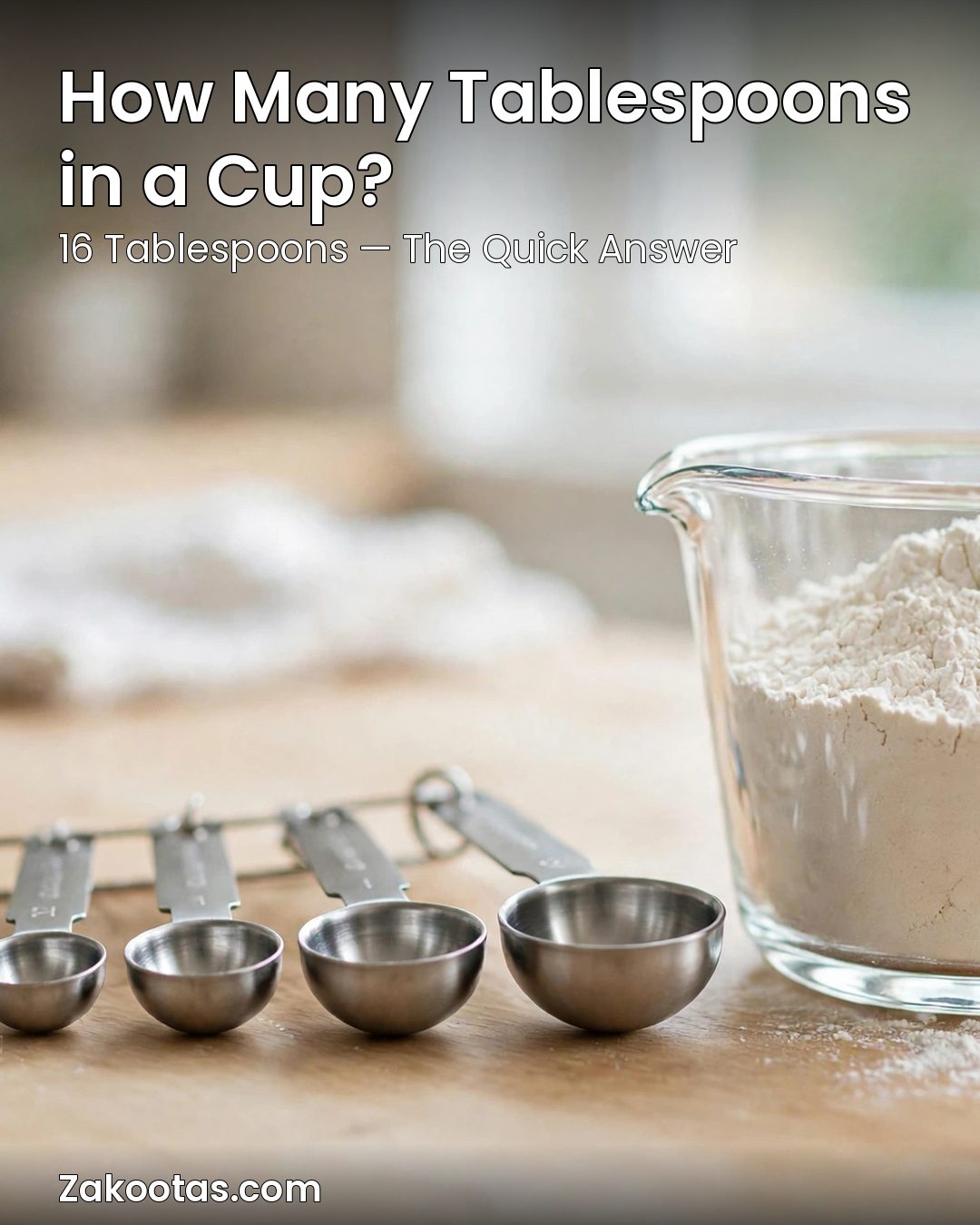
How Many Tablespoons in a Cup? 16 tbsp + Conversion Charts
There are 16 tablespoons in 1 US cup — for liquids and dry ingredients alike, because both the tablespoon and the cup measure volume. That single number unlocks the whole kitchen system: 4 tablespoons make a quarter cup, 8 make a half cup, 12 make three-quarters, and 16 fill the cup. Memorize 4-8-12-16 and you will never be stuck mid-recipe again.
But the number 16 only holds for US measures, and only for level tablespoons. A metric cup holds about 16.7 metric tablespoons, an Australian cup holds just 12.5 Australian tablespoons, and a heaped tablespoon can hold half as much again as a level one. This guide gives you the quick answer, the full fraction charts in both directions, the formulas, a butter-stick guide, the international differences, and the measuring technique that keeps your baking honest.
Quick Answer: How Many Tablespoons in a Cup?
1 US cup = 16 US tablespoons = 48 teaspoons = 8 fluid ounces = about 237 millilitres. That is the volume answer, and it never changes: water, milk, oil, flour, sugar — 16 level tablespoons fill one cup every time, because both units measure the same thing, volume.
| Amount | Tablespoons | Teaspoons | Fluid ounces | Millilitres |
|---|---|---|---|---|
| 1/16 cup | 1 tbsp | 3 tsp | 1/2 fl oz | 15 mL |
| 1/8 cup | 2 tbsp | 6 tsp | 1 fl oz | 30 mL |
| 1/4 cup | 4 tbsp | 12 tsp | 2 fl oz | 59 mL |
| 1/3 cup | 5 tbsp + 1 tsp | 16 tsp | 2 2/3 fl oz | 79 mL |
| 1/2 cup | 8 tbsp | 24 tsp | 4 fl oz | 118 mL |
| 2/3 cup | 10 tbsp + 2 tsp | 32 tsp | 5 1/3 fl oz | 158 mL |
| 3/4 cup | 12 tbsp | 36 tsp | 6 fl oz | 177 mL |
| 1 cup | 16 tbsp | 48 tsp | 8 fl oz | 237 mL |
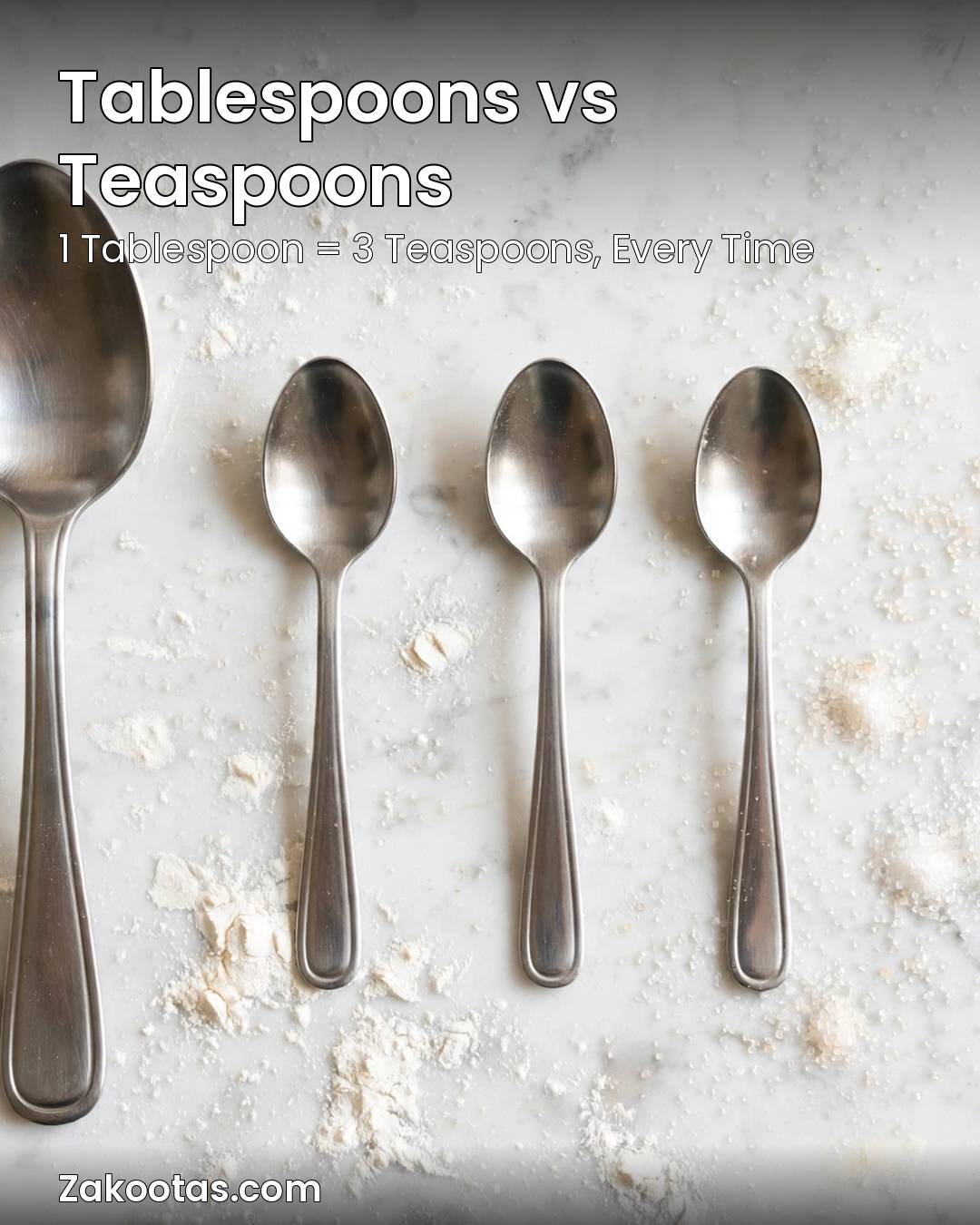
Tablespoons vs Teaspoons: The 3-to-1 Rule
The tablespoon and the teaspoon are linked by a simple ratio: 1 tablespoon = 3 teaspoons. That is why a cup holds 48 teaspoons — 16 tablespoons times 3. If a recipe calls for 1 tablespoon and you only have a teaspoon measure, use 3 level teaspoons. If it calls for 1 teaspoon and you only have a tablespoon, fill the tablespoon one-third full.
Why does the ratio matter beyond the maths? Because the two spoons get confused constantly. A tablespoon is the big spoon in a measuring set, roughly the size of a soup spoon; a teaspoon is the small one, roughly the size of a coffee-stirring spoon. Using one for the other triples or thirds your ingredient — the difference between a pinch of baking soda and a spoonful that makes your muffins taste soapy.
The full US kitchen ladder runs on powers of two and three, and it is worth learning as one chain: 3 teaspoons = 1 tablespoon, 2 tablespoons = 1 fluid ounce, 8 fluid ounces = 1 cup, 2 cups = 1 pint, 2 pints = 1 quart, 4 quarts = 1 gallon. Every conversion in this guide is just a step up or down that ladder.
Cups to Tablespoons Conversion Chart
Most recipes ask for cup fractions rather than whole cups, so here is the chart you will actually reach for. The only fractions that do not divide cleanly are the thirds — a third of a cup is 5 and one-third tablespoons, which in practice means 5 tablespoons plus 1 teaspoon, and two-thirds is 10 tablespoons plus 2 teaspoons.
| Cups | Tablespoons | Teaspoons | Fluid ounces |
|---|---|---|---|
| 1/8 cup | 2 tbsp | 6 tsp | 1 fl oz |
| 1/4 cup | 4 tbsp | 12 tsp | 2 fl oz |
| 1/3 cup | 5 tbsp + 1 tsp | 16 tsp | 2 2/3 fl oz |
| 1/2 cup | 8 tbsp | 24 tsp | 4 fl oz |
| 2/3 cup | 10 tbsp + 2 tsp | 32 tsp | 5 1/3 fl oz |
| 3/4 cup | 12 tbsp | 36 tsp | 6 fl oz |
| 1 cup | 16 tbsp | 48 tsp | 8 fl oz |
| 1 1/2 cups | 24 tbsp | 72 tsp | 12 fl oz |
| 2 cups | 32 tbsp | 96 tsp | 16 fl oz |
| 3 cups | 48 tbsp | 144 tsp | 24 fl oz |
| 4 cups | 64 tbsp | 192 tsp | 32 fl oz |
Tablespoons to Cups: The Formula
When a recipe gives you tablespoons and you need cups — the classic case is scaling a recipe up, or a sauce recipe that lists 24 tablespoons of stock — the formula is one division: cups = tablespoons ÷ 16. The reverse is one multiplication: tablespoons = cups × 16.
| Tablespoons | Cups | What it looks like |
|---|---|---|
| 1 tbsp | 1/16 cup | A splash — one spoonful |
| 2 tbsp | 1/8 cup | 1 fluid ounce |
| 4 tbsp | 1/4 cup | Half a stick of butter |
| 8 tbsp | 1/2 cup | One stick of butter |
| 12 tbsp | 3/4 cup | One and a half sticks of butter |
| 16 tbsp | 1 cup | Two sticks of butter |
| 24 tbsp | 1 1/2 cups | Three sticks of butter |
| 32 tbsp | 2 cups (1 pint) | Four sticks of butter |
| 48 tbsp | 3 cups | One and a half pints |
| 64 tbsp | 4 cups (1 quart) | Eight sticks of butter |
A practical shortcut for the common case: any tablespoon count up to 16 can be read off the 4-8-12-16 ladder. 4 is a quarter cup, 8 is a half, 12 is three-quarters, 16 is a full cup. For numbers between the rungs, add the remainder — 6 tablespoons is a quarter cup (4) plus 2 more, which is 3/8 of a cup; 10 tablespoons is a half cup (8) plus 2, which is 5/8 of a cup.
How Many Tablespoons in a Stick of Butter?
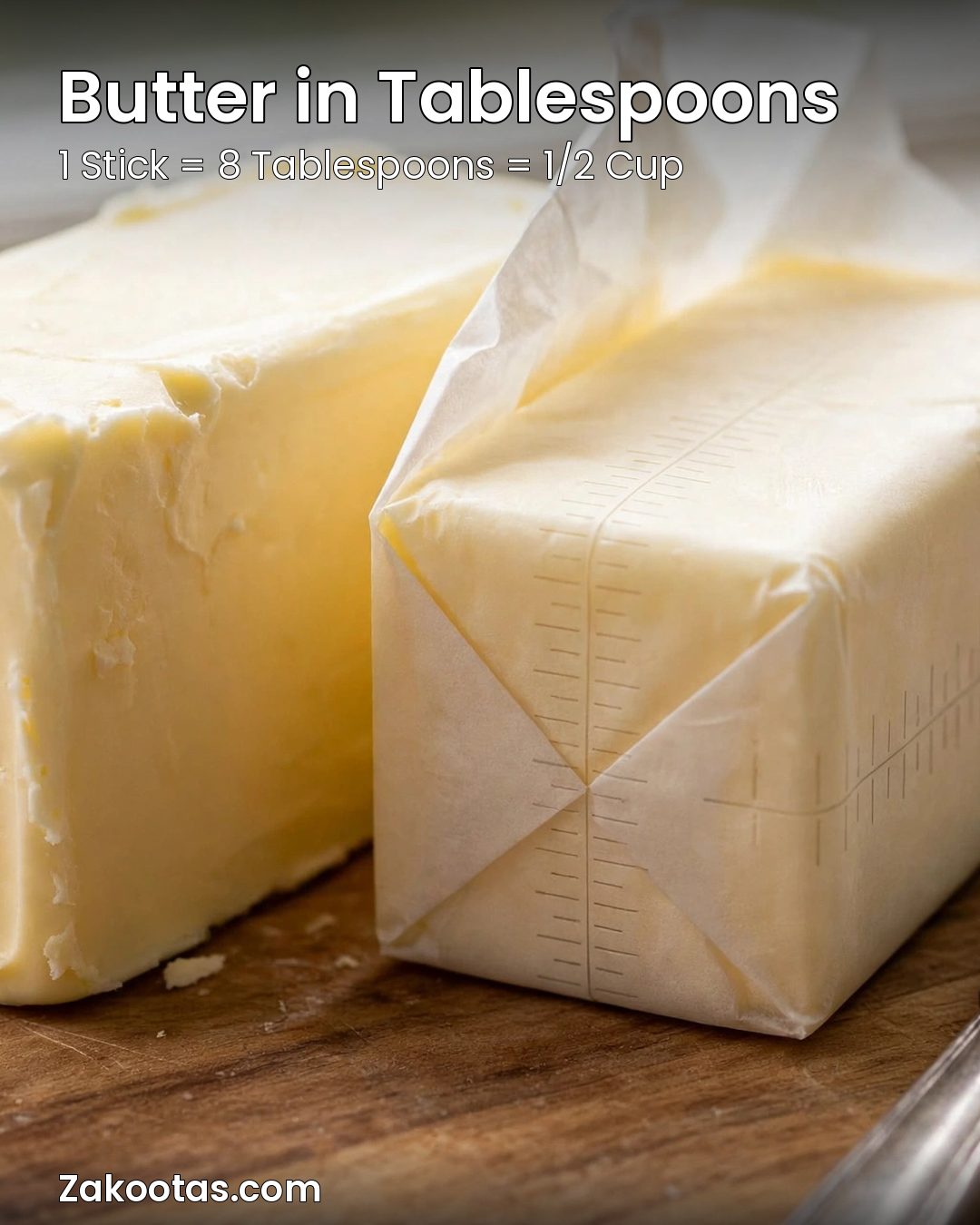
Butter is where the tablespoon-to-cup conversion earns its keep, because American butter is sold and marked by the tablespoon. One standard stick of butter is 8 tablespoons, which is 1/2 cup, 4 ounces and about 113 grams. Two sticks make a full cup — 16 tablespoons. The wrapper of every US butter stick is printed with tablespoon markings, so you can cut straight along the lines without measuring at all.
| Butter | Tablespoons | Cups | Ounces | Grams |
|---|---|---|---|---|
| 1/4 stick | 2 tbsp | 1/8 cup | 1 oz | 28 g |
| 1/2 stick | 4 tbsp | 1/4 cup | 2 oz | 57 g |
| 1 stick | 8 tbsp | 1/2 cup | 4 oz | 113 g |
| 1 1/2 sticks | 12 tbsp | 3/4 cup | 6 oz | 170 g |
| 2 sticks | 16 tbsp | 1 cup | 8 oz | 227 g |
Butter is also the clearest proof that tablespoons measure volume, not weight. A tablespoon of butter weighs about 14 grams, a tablespoon of flour about 8 grams, a tablespoon of sugar about 12.5 grams and a tablespoon of honey about 21 grams — same spoon, wildly different weights. So when a recipe says “tablespoons”, it always means volume, and the cup conversion (16 per cup) holds for every ingredient. When it says “ounces” for a dry ingredient, it means weight, and you need a scale or an ingredient chart — see our guide to how many ounces in a cup for the dry-ounce weights of 12 common ingredients.
US vs Metric vs Australian Tablespoons
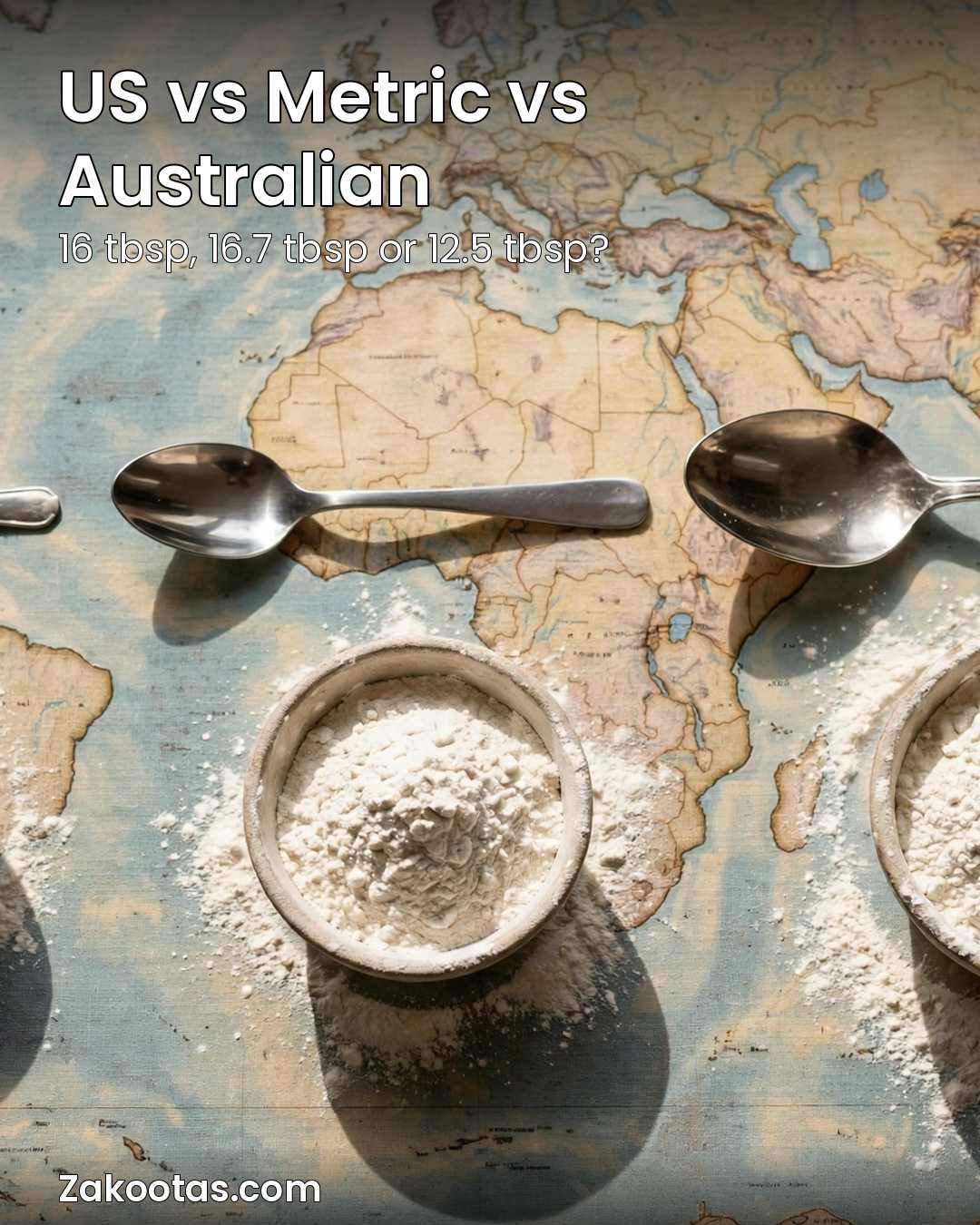
The tablespoon is not one size worldwide, and neither is the cup — so “16 tablespoons in a cup” is strictly a US fact. The three systems in common use differ enough to ruin a bake if you mix them up.
| System | 1 tablespoon | 1 cup | Tablespoons per cup |
|---|---|---|---|
| US customary | 14.79 mL (1/2 fl oz) | 236.59 mL | 16 |
| Metric (UK, Canada, NZ) | 15 mL | 250 mL | 16.7 |
| Australian | 20 mL (4 tsp) | 250 mL | 12.5 |
| Imperial (historic UK) | 17.76 mL | 284.13 mL | 16 |
The Australian case is the dangerous one: an Australian tablespoon holds 20 mL, a third more than a US tablespoon, and an Australian cup holds 250 mL. An Australian recipe that calls for “1 cup” measured with US spoons needs only 12.5 Australian tablespoons — use 16 US tablespoons and you have added about 28% too much. The metric difference is smaller but still real: a metric cup of 250 mL is about 5% larger than a US cup, so 16 US tablespoons in a metric recipe leaves you about 5% short — harmless in a stew, enough to matter in a macaron or a sponge.
One more wrinkle: the US “legal cup” used on nutrition labels is exactly 240 mL, not 236.59 mL, which works out to about 16.2 tablespoons. The difference is under 2% and invisible in practice, but it explains why some charts round the cup to 240 mL. For everyday cooking, 16 tablespoons per cup is the number to use.
How to Measure a Tablespoon Correctly
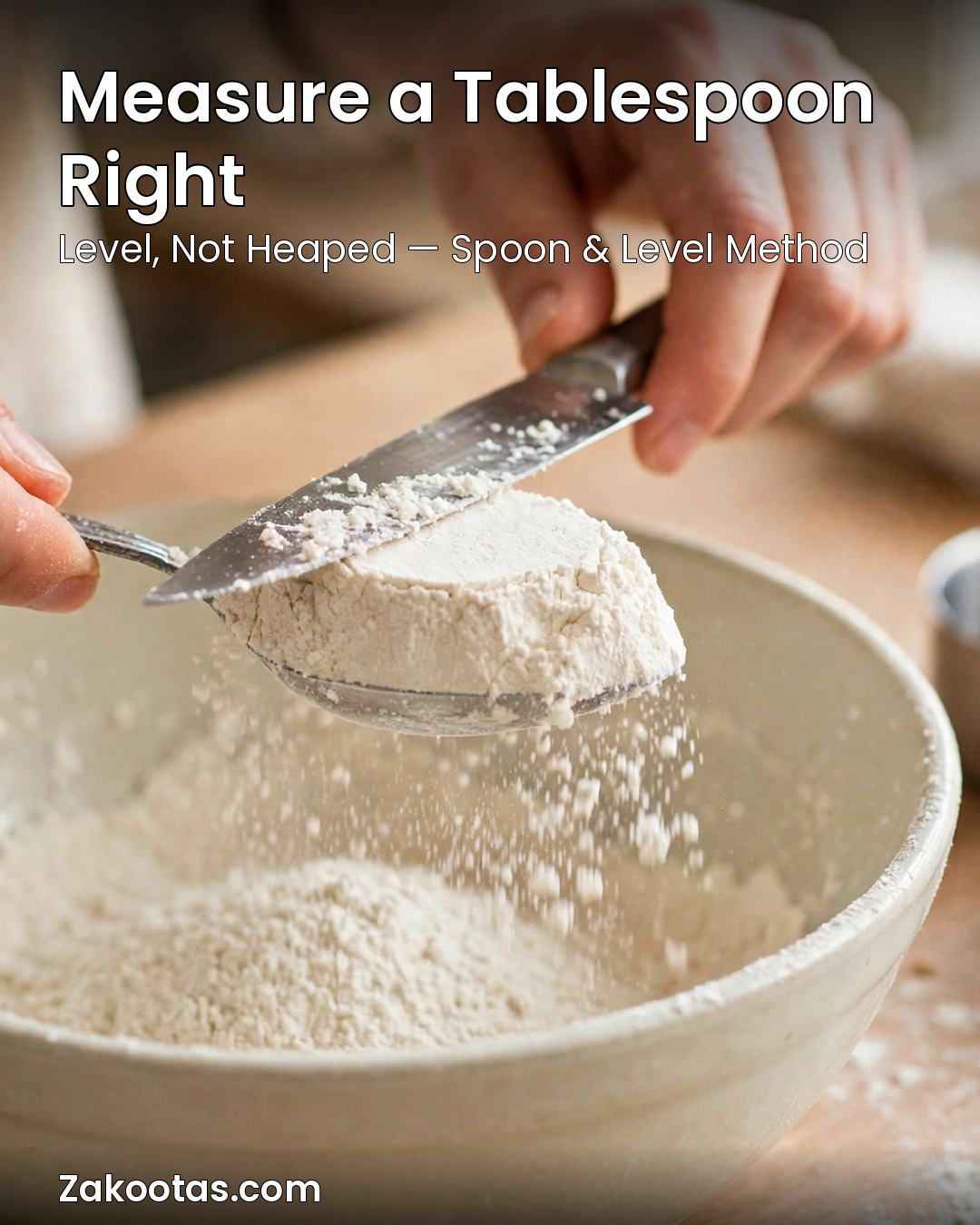
The conversion is exact only if the tablespoon is level. A heaped tablespoon of flour can hold 50% more than a level one, and a rounded tablespoon of baking powder can double the leavening in a cake. Three habits keep your measurements honest.
Use real measuring spoons, not cutlery. A tablespoon from the cutlery drawer is not a measuring tablespoon — dinner spoons vary from about 10 mL to 20 mL, and a soup spoon can hold far more than 15 mL. Measuring spoon sets are cheap and the only reliable way to hit 16 tablespoons per cup.
Spoon and level dry ingredients. Spoon the ingredient into the tablespoon so it mounds above the rim, then sweep a knife flat across the top to level it off. Never scoop directly from the bag with the spoon — that packs the ingredient in and adds up to 30% extra flour. For more on measuring dry ingredients by the cup, see our guide to how many ounces in a cup.
Fill liquids to the brim, at eye level. A tablespoon of liquid should be filled right to the rim without spilling over — hold the spoon over the bowl so drips land where they belong. For sticky ingredients like honey or peanut butter, lightly oil the spoon first and the ingredient will slide out cleanly.
Common Mistakes When Converting Tablespoons and Cups
Mixing up tablespoons and teaspoons. The abbreviations look alike — tbsp vs tsp — and swapping them triples or thirds an ingredient. Write the full word out in your own recipe notes if you are copying a recipe by hand.
Using a heaped spoon as a level spoon. Recipes mean level unless they say “heaped” or “rounded”. A heaped tablespoon of cocoa in a cake is a flavour change; a heaped tablespoon of baking soda is a failed bake.
Assuming 16 everywhere. The 16-tablespoon rule is US-only. If the recipe is Australian, British or from a metric source, check which cup and spoon it means — 12.5 Australian tablespoons per cup is a very different answer.
Measuring flour by the spoonful without levelling. Sixteen unlevelled tablespoons of flour can be 20% more flour than a cup. Spoon, level, and if the recipe matters, weigh: a cup of flour is about 120 grams.
Forgetting the thirds. A third of a cup is not 5 tablespoons — it is 5 tablespoons plus 1 teaspoon, and two-thirds is 10 tablespoons plus 2 teaspoons. Rounding those down is a small error per cup, but it compounds across a doubled recipe.
Everyday Amounts: The Tablespoon–Cup Ladder
Zoom out one step and the tablespoon sits in the middle of the whole US volume system. One tablespoon is 3 teaspoons; 2 tablespoons make a fluid ounce; 16 tablespoons make a cup; 32 make a pint; 64 make a quart; 256 make a gallon. Climbing the ladder: 1 gallon = 256 tablespoons, 1 quart = 64, 1 pint = 32, 1 cup = 16, 1 fluid ounce = 2, 1 tablespoon = 3 teaspoons. If you need the bigger conversions, our guides to how many cups in a quart and how many cups in a liter cover the quart, pint, gallon and metric sides of the same ladder.
Frequently Asked Questions
How many tablespoons are in a cup?
There are 16 US tablespoons in 1 US cup. That is also 48 teaspoons, 8 fluid ounces and about 237 millilitres.
How many tablespoons in 1/2 cup?
There are 8 tablespoons in half a cup. A quarter cup is 4 tablespoons and three-quarters of a cup is 12 tablespoons.
How many tablespoons in 1/3 cup?
There are 5 tablespoons plus 1 teaspoon in one-third of a cup, because 16 divided by 3 is 5 and one-third, and one-third of a tablespoon is exactly 1 teaspoon. Two-thirds of a cup is 10 tablespoons plus 2 teaspoons.
How many teaspoons in a tablespoon?
There are 3 teaspoons in 1 tablespoon. That is why 1 cup holds 48 teaspoons: 16 tablespoons times 3.
How many tablespoons in a stick of butter?
One stick of butter is 8 tablespoons, which is half a cup, 4 ounces and about 113 grams. Two sticks make 1 cup, or 16 tablespoons. US butter wrappers are printed with tablespoon markings for easy cutting.
How many tablespoons in a cup in Australia?
There are 12.5 Australian tablespoons in 1 Australian cup, because an Australian tablespoon holds 20 mL and an Australian cup holds 250 mL. Do not use the US figure of 16 with Australian recipes — it adds about 28% too much.
Is a tablespoon the same as a dessert spoon?
No. A dessert spoon holds about 10 mL, or 2 teaspoons — between a teaspoon (5 mL) and a tablespoon (15 mL). It is a serving spoon in the UK and Australia, not a standard measuring unit, so do not substitute it for a tablespoon in a recipe.
How many tablespoons in 2 cups?
There are 32 tablespoons in 2 cups (2 × 16). Two cups is also 1 pint, 16 fluid ounces and about 473 millilitres.
Remember the ladder: 4 tablespoons is a quarter cup, 8 is a half, 12 is three-quarters and 16 fills the cup. With that and the ÷16 formula for anything larger, you can convert any amount in either direction without reaching for your phone — though this page will be here when you need the thirds.