How a Negative Tone Destroys Relationships (And How to Fix It)
“It’s not what you said, it’s how you said it.” If you’ve heard this phrase repeatedly in your relationship, or if you find yourself saying it to your partner, you’re dealing with a tone problem. A negative tone can poison communication even when the actual words are reasonable. It creates emotional wounds, erodes trust, and slowly destroys intimacy. The good news? Once you recognize tone issues, you can learn to change them.
Tone refers to the emotional quality and attitude conveyed through your voice, facial expressions, body language, and word choice. A negative tone communicates contempt, criticism, defensiveness, or hostility regardless of whether your words are technically neutral or even positive. Understanding how tone negative patterns develop, why they’re so damaging, and how to repair them is essential for anyone who wants to maintain healthy relationships.
Why Tone Matters More Than You Think
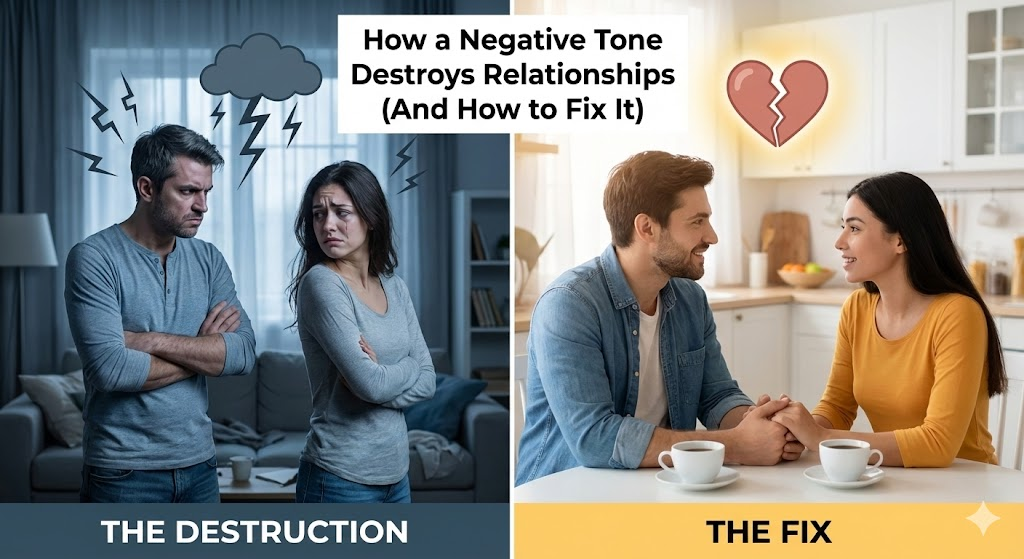
Most people significantly underestimate the impact of their tone in conversations. We focus on what we’re saying, believing that if our words are factually correct or our concerns are valid, our delivery shouldn’t matter. This is fundamentally wrong. Research consistently shows that tone carries more weight than content in determining how messages are received and whether communication succeeds or fails.
The Science Behind Tone and Emotional Processing
Research insight: Studies in communication and neuroscience demonstrate that humans process emotional tone faster and more deeply than verbal content. Your brain registers your partner’s tone of voice and facial expressions before consciously processing their words. This means a negative tone triggers defensive reactions before your partner even fully understands what you’re saying.
When you speak with a negative tone, you’re essentially sending two messages simultaneously: the content of your words and the emotional message of your delivery. Even if your words are constructive criticism delivered for good reasons, a contemptuous or harsh tone communicates, “I don’t respect you” or “You’re inadequate.” Your partner responds to the emotional message, not the content, leading to arguments about tone rather than productive discussions about the actual issue.
How Negative Tone Escalates Conflicts
A negative tone doesn’t just make individual conversations harder—it creates escalating patterns that damage relationships over time. When you speak with contempt, sarcasm, or hostility, your partner typically responds defensively or with their own negative tone. This creates a cycle where both people feel attacked and neither feels heard, turning minor disagreements into major fights.
Over time, these patterns become habitual. You stop giving each other the benefit of the doubt. Every conversation carries the potential for conflict. Eventually, people start avoiding communication altogether because it feels too risky, leading to emotional distance and relationship deterioration.
Common Types of Negative Tone in Relationships
Understanding the specific ways negative tone manifests helps you recognize these patterns in your own communication. Most people don’t intend to be hurtful with their tone, but these behaviors become automatic responses to stress, frustration, or feeling unheard.
Contempt: The Most Destructive Tone
Contempt involves communicating from a position of superiority, treating your partner as inferior, stupid, or worthless. This is the most toxic form of negative tone and the strongest predictor of relationship failure according to relationship researcher John Gottman. Contempt communicates disgust and disrespect in ways that cut deep.
What contempt sounds like:
- Sarcasm: “Oh, great job forgetting again. You’re so reliable.”
- Mockery: “Wow, what a brilliant idea” (said with eye roll)
- Name-calling: “You’re being ridiculous/crazy/dramatic”
- Disgust: Heavy sighs, sneering, looking away while partner talks
- Belittling: “That’s the dumbest thing I’ve ever heard”
Contempt is particularly damaging because it attacks your partner’s character and worth rather than addressing specific behaviors. It’s nearly impossible to have productive conversations when one person is communicating contempt, because the other person is focused on defending their basic dignity rather than hearing the underlying concern.
Criticism Delivered Harshly
There’s a difference between complaining about a specific behavior and criticizing your partner’s character, but even legitimate complaints become destructive when delivered with a harsh, attacking tone. Harsh criticism often includes absolutes like “you always” or “you never” and focuses on what’s wrong with your partner rather than what you need.
Harsh critical tone:“You NEVER help around the house! I’m always the one doing everything while you just sit there. You’re so lazy and selfish.”
Constructive tone:“I’m feeling overwhelmed with housework lately. Can we talk about dividing tasks more evenly? I need more support.”
The first example attacks character with a harsh tone and absolute statements. The second addresses the same issue but focuses on needs and invites collaboration rather than attacking. The tone makes all the difference in whether this conversation leads to change or a fight.
Defensiveness and Counter-Attacking
Defensive tone often emerges in response to criticism, but it prevents resolution by refusing to acknowledge any validity in your partner’s concerns. Defensive responses typically involve making excuses, counter-attacking, or playing the victim, all delivered with a tone that says “how dare you suggest I did anything wrong.”
What defensive tone sounds like:
- Counter-attacking: “Oh really? What about when YOU forgot my birthday?”
- Making excuses: “I was busy! You don’t understand how hard my day was!”
- Victim mentality: “Nothing I do is ever good enough for you”
- Denying responsibility: “That’s not what happened. You’re remembering it wrong.”
Defensiveness communicates that you’re not willing to hear your partner’s concerns or take responsibility for your actions. The tone signals that you’re more interested in winning the argument than understanding your partner’s perspective, which shuts down productive communication.
Passive-Aggressive Tone
Passive-aggressive tone involves expressing hostility indirectly through subtle digs, backhanded compliments, or saying positive words with negative delivery. This communication style is particularly frustrating because it allows the speaker to deny their hostility while still inflicting emotional damage.
What passive-aggressive tone sounds like:
- “I’m FINE” (said in a tone that clearly means “I’m not fine and you should know why”)
- “Don’t worry about it. I’ll just do everything myself like always.”
- “Must be nice to have so much free time” (implying your partner is lazy)
- Giving someone the silent treatment or brief, cold responses
Passive-aggressive communication makes it difficult to address issues directly because the speaker won’t acknowledge their true feelings. The negative tone creates tension without providing any path forward for resolution.
Dismissive or Condescending Tone
A dismissive tone communicates that your partner’s thoughts, feelings, or concerns don’t matter or aren’t worth taking seriously. Condescension treats your partner like a child who doesn’t understand rather than an equal partner. Both create profound feelings of invalidation and disrespect.
What dismissive/condescending tone sounds like:
- “You’re overreacting” or “You’re too sensitive”
- “Let me explain this to you…” (speaking as if to a child)
- “That’s not a real problem” or “You’re making a big deal out of nothing”
- Interrupting, talking over, or looking at phone while partner speaks
- “Calm down” (said in an exasperated tone when partner is expressing emotion)
Dismissive and condescending tones are particularly damaging to emotional intimacy because they communicate that you don’t value your partner’s inner experience. Over time, your partner will stop sharing their thoughts and feelings with you altogether.
Why We Fall Into Negative Tone Patterns
Understanding why negative tone develops helps you approach changing it with self-compassion rather than shame. Most people don’t wake up deciding to be contemptuous or dismissive toward someone they love. These patterns develop for understandable reasons, even though they’re ultimately destructive.
Learned Communication Patterns from Childhood
Many people learned negative tone from the communication patterns they observed and experienced growing up. If your parents spoke to each other with contempt, if you were criticized harshly as a child, or if sarcasm was the primary form of family humor, you may have internalized these patterns as normal communication. You’re essentially recreating the tone environment you grew up in without consciously choosing it.
This doesn’t excuse negative tone, but it explains why breaking these patterns requires conscious effort. You’re working against years of conditioning that taught you this is how people who love each other talk to one another.
Feeling Unheard or Chronically Frustrated
Negative tone often escalates when people feel their concerns aren’t being taken seriously. If you’ve brought up the same issue multiple times with no change, frustration builds until it leaks out through harsh tone, even when you’re trying to stay calm. The negative tone isn’t really about the current situation but about accumulated resentment from feeling ignored.
Similarly, if you don’t feel your partner respects you or values your contributions, that disrespect might manifest as a chronically negative tone toward them. Your tone becomes a weapon expressing feelings you haven’t addressed directly.
Stress and Emotional Regulation Difficulties
When you’re stressed, tired, overwhelmed, or emotionally dysregulated, you have less capacity to monitor and control your tone. You might snap at your partner or speak more harshly than you intend simply because you don’t have the emotional bandwidth to be careful with your delivery. This is especially true if you struggle with anxiety, depression, or unresolved trauma that affects emotional regulation.
While understandable, this creates a cycle where your partner starts walking on eggshells around you, afraid of triggering your negative tone during stressful periods. This isn’t sustainable for healthy relationships.
Power Struggles and Control Issues
Sometimes negative tone serves a function in relationship dynamics, even if unconsciously. Contemptuous or dismissive tone can be a way of maintaining power or control, ensuring your partner doesn’t challenge you or make demands. If you feel threatened by conflict or by your partner asserting needs, a harsh tone might effectively shut them down and prevent conversations you find uncomfortable.
This is deeply problematic because it prioritizes your comfort over the health of the relationship and your partner’s wellbeing. Healthy relationships require both partners to have equal voice and influence, which is impossible when negative tone is used to dominate.
The Cumulative Damage of Negative Tone
A single instance of negative tone in an otherwise healthy relationship won’t destroy things. However, when negative tone becomes a consistent pattern, it creates profound damage that accumulates over time.
Erosion of Trust and Safety
Emotional safety requires knowing you can be vulnerable with your partner without being attacked, mocked, or dismissed. When negative tone is common, that safety disappears. Your partner never knows when they might trigger a contemptuous response, so they start censoring themselves, hiding their true thoughts and feelings, or avoiding topics that might lead to conflict.
This erosion of safety kills intimacy. Deep connection requires vulnerability, and vulnerability requires trust that your partner will handle your heart carefully. Negative tone communicates the opposite, teaching your partner that sharing themselves honestly is dangerous.
Creation of Relationship “Schemas”
Warning sign: When negative tone becomes habitual, both partners develop negative schemas about the relationship and each other. You start assuming bad intentions, interpreting neutral statements negatively, and bracing for attack in every conversation. These negative expectations become self-fulfilling prophecies that poison even positive interactions.
Once negative schemas develop, you stop giving your partner the benefit of the doubt. A benign comment gets interpreted as criticism. An attempt to discuss an issue gets perceived as an attack. Both people enter conversations already defensive, making productive communication nearly impossible.
Impact on Physical and Mental Health
Living in a relationship characterized by negative tone creates chronic stress that affects both physical and mental health. The constant tension, hypervigilance about avoiding conflict, and emotional wounds from contemptuous treatment contribute to anxiety, depression, sleep problems, and even physical health issues like cardiovascular problems and weakened immune function.
Being regularly on the receiving end of negative tone is emotionally exhausting and can significantly damage self-esteem, especially when the tone is contemptuous or dismissive. Over time, you may internalize the messages that you’re not worthy of respect or that your feelings don’t matter.
How to Fix Negative Tone in Your Relationship
Changing tone patterns requires commitment, self-awareness, and consistent practice. It won’t happen overnight, but improvement is absolutely possible for people willing to do the work. Here are evidence-based strategies for fixing tone problems.
Step 1: Acknowledge the Problem Without Defensiveness
The first step is genuinely accepting that your tone is a problem, not just your partner being oversensitive. This requires humility and willingness to receive feedback without becoming defensive. If your partner repeatedly tells you your tone is hurtful, believe them. Their perception of your tone matters more than your intention.
How to take responsibility:
“I’m realizing that my tone has been hurtful even when I didn’t intend it. I want to work on this because I love you and want our communication to feel better for both of us. Will you help me by pointing out when my tone feels harsh so I can become more aware of it?”
This response acknowledges the problem, takes responsibility, and invites collaboration rather than getting defensive or making excuses. It creates space for change.
Step 2: Identify Your Tone Triggers
Most people don’t have a negative tone all the time—it emerges in specific situations or around particular topics. Identifying your triggers helps you anticipate when you need to be extra careful about your delivery.
Self-reflection questions:
- When is my tone most negative? (Times of day, stress levels, specific topics)
- What emotions precede my negative tone? (Frustration, feeling disrespected, anxiety)
- Are there patterns from my past that I’m recreating?
- What am I really feeling when I use a harsh tone? (Often it’s vulnerability beneath the anger)
Understanding your triggers allows you to pause before responding when you’re in a high-risk situation for negative tone. You can say, “I need a minute to collect myself before we discuss this” rather than launching into a conversation you’re too activated to handle well.
Step 3: Practice the Pause
One of the most powerful tools for changing tone is simply pausing before responding, especially when you’re feeling emotional. This brief pause gives you time to notice your emotional state, choose your words more carefully, and intentionally soften your delivery.
The Pause Technique:
When you feel strong emotion rising, take a literal breath before speaking. In that breath, ask yourself: “How do I want to say this? What tone will help my partner actually hear me?” This two-second intervention can prevent hours of conflict repair.
If you’re too activated to speak constructively even with a pause, it’s appropriate to take a longer break. Say something like, “I need 20 minutes to calm down so I can discuss this productively” and then actually return to the conversation once you’ve regulated your emotions.
Step 4: Soften Your Startup
How you begin difficult conversations largely determines how they’ll go. Starting with harsh criticism or a negative tone almost guarantees defensiveness and escalation. Instead, practice “soft startup” where you begin conversations gently, focusing on your needs rather than your partner’s failures.
Harsh startup:“You’re on your phone AGAIN! You never pay attention to me. You care more about your stupid games than your own partner!”
Soft startup:“Hey, I’m feeling disconnected from you right now. Can we put our phones away and talk for a bit? I miss you.”
The soft startup communicates the same underlying need (wanting connection and attention) but with a tone that invites cooperation rather than triggering defensiveness. It focuses on feelings and needs rather than accusations and character attacks.
Step 5: Replace Contempt with Appreciation
Contempt is the most toxic tone, but the antidote is straightforward: appreciation and respect. When you find yourself feeling contemptuous, pause and deliberately recall something you appreciate about your partner. This doesn’t mean ignoring legitimate concerns, but it means approaching issues from a foundation of respect rather than superiority.
Make it a practice to regularly express appreciation for your partner, even for small things. This creates a positive emotional climate that makes occasional negative feedback easier to hear and prevents the buildup of resentment that fuels contemptuous tone.
Step 6: Use “I” Statements Instead of “You” Accusations
The structure of your sentences affects your tone. Starting sentences with “you” followed by a criticism almost automatically creates an attacking tone. Restructuring your concerns as “I” statements naturally softens delivery and focuses on your experience rather than your partner’s deficiencies.
Formula for “I” statements:
“I feel [emotion] when [specific behavior] because [impact on you]. I need [specific request].”
Example: “I feel anxious when plans change last minute because I need predictability to feel settled. Can we try to stick to plans we’ve made or give me more notice when something comes up?”
This formula keeps you focused on your internal experience and needs rather than judging your partner’s character or intentions. It’s nearly impossible to sound contemptuous when you’re genuinely expressing vulnerability and making clear requests.
Step 7: Repair Quickly When You Mess Up
You will mess up. Even with the best intentions, you’ll sometimes slip into old patterns of negative tone. What matters is catching it and repairing quickly rather than doubling down or getting defensive about it.
Effective repair statements:
- “I’m sorry, that came out harsh. Let me try again with a better tone.”
- “You’re right, my tone was disrespectful just now. I apologize. What I meant to say is…”
- “I can hear how that sounded. That’s not okay. I’m working on this and I’ll do better.”
Quick repairs prevent small tone problems from escalating into huge fights. They also demonstrate to your partner that you’re serious about changing and that you value their feelings enough to take responsibility immediately.
Step 8: Address Underlying Issues
If your negative tone stems from deeper relationship problems like feeling disrespected, unappreciated, or unheard, you need to address those root issues directly. The tone is a symptom, not the disease. Having honest conversations about the state of your relationship, potentially with a couples therapist, can address the underlying resentment or frustration that fuels negative tone.
Similarly, if your tone problems are connected to your own mental health struggles, trauma history, or emotional regulation difficulties, individual therapy can provide tools for managing these issues so they don’t poison your relationships.
When Your Partner Has the Negative Tone Problem
If you’re on the receiving end of consistently negative tone, you face a different set of challenges. You need to protect yourself emotionally while also helping your partner recognize and change their patterns if possible.
Don’t Accept Gaslighting About Tone
Important: Some people respond to feedback about their tone by insisting you’re too sensitive, overreacting, or misinterpreting them. This is gaslighting. Your perception of tone is valid. If your partner consistently makes you feel small, disrespected, or attacked through their tone, that’s real and not your fault.
Trust your gut about how your partner’s tone makes you feel. If their words say one thing but their tone communicates contempt or hostility, the tone is the truth. Don’t let anyone convince you that the problem is your perception rather than their delivery.
Set Clear Boundaries
You can set boundaries around tone without controlling your partner. A boundary might sound like, “I’m willing to discuss this, but not when you’re speaking to me with contempt. When you can talk to me respectfully, I’m ready to listen.” Then follow through by ending the conversation if the negative tone continues.
Setting boundaries requires consistency. If you say you won’t tolerate contemptuous tone but then continue engaging with it, you’re teaching your partner that your boundaries are negotiable. It’s okay to walk away from conversations that are disrespectful, even if the topic is important. You can revisit it when productive communication is possible.
Don’t Match Their Negative Tone
When your partner speaks with negative tone, it’s tempting to mirror that tone in response. Resist this urge. Matching negative tone creates escalation where both people are attacking rather than communicating. Instead, consciously maintain a calm, respectful tone yourself. This doesn’t mean accepting mistreatment, but it means not adding fuel to the fire.
You might say something like, “I notice you’re speaking pretty harshly right now. I want to hear what you’re saying, but it’s hard when the tone feels attacking. Can we reset?” This addresses the tone directly while modeling the respectful communication you’re asking for.
Consider Whether the Relationship Is Salvageable
If you’ve clearly communicated how your partner’s tone affects you, they’ve acknowledged it, but nothing changes over time despite your best efforts, you need to consider whether this relationship is healthy for you. Consistent negative tone, especially contempt, is emotionally abusive and deeply damaging to your wellbeing.
A partner who genuinely cares about you will work to change hurtful patterns when you make clear they’re causing harm. If your partner refuses to acknowledge the problem, becomes defensive every time you bring it up, or makes short-lived efforts followed by return to old patterns, they’re showing you through actions that they’re not willing to prioritize your emotional safety. That’s valuable information about whether this relationship should continue.
Final Thoughts: The Power of Tone in Building or Breaking Relationships
Tone negative communication is one of the most insidious relationship destroyers because it damages connection in ways that are difficult to articulate and easy to deny. When someone says “it’s not what you said, it’s how you said it,” they’re pointing to a real problem that deserves serious attention, not dismissal.
The good news is that tone is learnable and changeable. Unlike many relationship challenges that involve fundamental incompatibility, tone problems are primarily about skills and awareness. With commitment, practice, and often professional help, people can learn to communicate their concerns, frustrations, and needs in ways that invite cooperation rather than triggering defensiveness.
If you recognize yourself in the descriptions of negative tone patterns, take heart. Awareness is the first step toward change, and your willingness to examine your communication honestly suggests you’re capable of growth. Start small, practice self-compassion when you stumble, repair quickly when you mess up, and gradually you’ll find that changing your tone changes not just individual conversations but the entire emotional climate of your relationship.
If you’re on the receiving end of chronic negative tone, know that you deserve to be spoken to with respect and kindness, even during disagreements. Your feelings about your partner’s tone are valid. Set boundaries, advocate for yourself, and if necessary, recognize when a pattern is so entrenched that the healthiest choice is to leave.
Ultimately, tone is a choice. It’s not always an easy choice, especially when old patterns run deep, but it is a choice. And the choice to speak with respect, warmth, and care toward your partner, even during difficult conversations, is one of the most important investments you can make in the long-term health and happiness of your relationship. Your words matter, but how you say them matters even more.